Sunday, 15 August 2021

Wildflower heaven, and the working party ends with a bang!

The supply of visitors to your usual correspondent having temporarily dried up, he has made a surprise return to the fold. So numerous are the newly recruited volunteers, half the assembled workers have no idea who he is. I have to tell you dear reader, he is the one responsible for this drivel.

Since the last posting of this blog, there has been a sharp uptick in the level of activity; our volunteers are back, looking after the best interests of the local birds and bees, beetles and butterflies, and of course the botanicals. The start date of Natural England’s cutting programme for the SSSI has now passed, and the first working parties are under our collective belt. On Friday 6th Team Leaders Julie and Margaret toiled away for a couple of hours in the central area, cutting four bagfuls of reeds by hand, in order to avoid the need for the mower to be used there, and thus protect the most prolific of the wild flowers which have not yet set seed.

It was warm work in high humidity, but then a heavy shower came along. Fortunately they were able to take shelter in the tool store, but then decided to remove some Himalayan Balsam plants that were encroaching into the reedbed – the now very wet reeds transferring much of their recently acquired rain onto the two plucky adventurers.

On Saturday 7th a significant milestone was reached, with the scattering of seeds on our embryo wildflower meadow at Pit Common. A lot of hard work had already been put into preparing the ground, by way of removing pernicious weeds like Dock and Hogweed, as well as removing a good proportion of the turf in the selected and roped-off section of the Common. More of that went on before the arrival of the seeds, which had been collected that morning by Aaron, NWT’s expert in these matters. He arrived in a car laden with newly mown plants, as well as a couple of buckets containing seeds mixed with sand. Here’s how the site looked during its preparation:

The loose seeds were scattered across the patch, and then the ‘green hay’ as it is known was strewn on top; the idea being that there will be many more seeds contained in it. Seeds in the mix included oxeye daisy, sulphur clover, field scabious, yellow rattle, cowslip, common bird’s-foot-trefoil and meadow vetchling. The yellow rattle is particularly useful, as it parasitises several grass species, weakening them enough to give other plants a chance to thrive. Passers-by will have been struck by the sight of seven people apparently doing some kind of primitive dance, as the hay was trodden down.

They will rightly have surmised that it was a rain dance, because a few hours later the heavens opened and considerable precipitation was the result. Here the dancers are, sheltering from the rain during a less extreme shower; don’t they look surprisingly cheerful?

In addition to the main section, a small patch at the far end of the site patronised by moles was also treated in the same way. Aaron has recommended a spring cut of the flower area in March with the ‘arisings’ removed, and then a cut in August/September after the seeds have set. These can then be used to gradually increase the wildflower area, using the same technique.

Here’s how the site looked after the ritual strewing was complete.

The next session was on Friday 13th when six brave souls fought their way through the reed to remove the Himalayan Balsam infesting both sides of the Beck on Area F, near the car park. As Team Leader Julie reports, “The reed and Balsam towered above all of us and after last night’s rain it was a very wet job! Luckily no one fell in the Beck though!


We were pleased to see that there was considerably less balsam than last year in this area so our effortsare not in vain.”

Nonetheless, a reasonable haul was evident by the end. Here are those snazzy braces again, with Team Leader Kevin modelling his new plastic skirt for good measure; the voluminous look is in this year! 


15 volunteers (including four recently recruited ones) arrived in the late summer but early morning sunshine on Sunday 15th, eager to squelch around in the mud whilst clearing the recently cut reed and grass from the central area of the Common, so evocatively named Area G.

As usual, the work required nifty use of the pitchfork, heaving the heavy wet stuff onto drag sheets for winching to the dump site at the edge of the area.


Team Leader Julie wielded her camera to artistic effect, spotting the moment when it seemed a spotlight had picked out Andrew in mid-dance.

Now we are back with refreshments allowed, at half-time we gathered together for the customary group photo; not in the reeds I hasten to add, but on the cunningly well-hidden boardwalk.

We often focus on fashion in this blog; with Team Leader Kevin and his snazzy braces absent, the day was saved by this fetching matching ensemble, created by Norfolk Wildlife Trust and modelled by Pauline and Richard.

Neither of the two photographers on duty remembered to take a shot of the area once our work was done, but this one gives a reasonable impression of what it looks like now, although you must try to imagine it without the quartet of volunteers.

A lot of the equipment we use is transported from its store to close to where it’s needed on a little green trolley. This has a wheel at each corner, theoretically making it easier to pull to where it is wanted. As it seemed harder going than usual on its way back to the tool store, we noticed that the pneumatic tyres lacked an adequate amount of the requisite component; air. Your correspondent sought to rectify the situation by using the foot pump he so wisely carries in his car, and started pumping the tyres from 0 to the correct pressure as embossed on the tyre wall. All went well for the first tyre, and indeed it seemed it had for the second, until with an almighty bang, it burst! The evidence is presented for all to see:

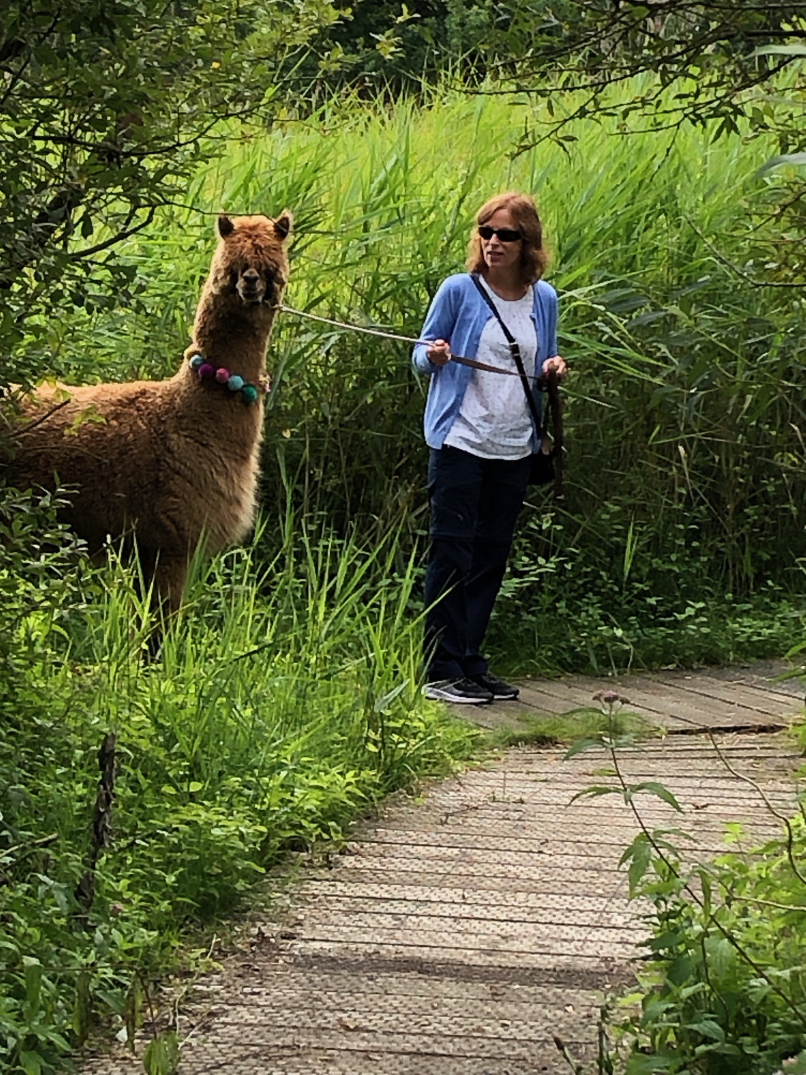
A couple of minutes later the regular troop of Alpacas processed along the boardwalk, and took a keen interest in the aftermath of the event. Luckily, they did not seem to have been traumatised by the recent explosion, unlike your correspondent, who took some persuading that he had not in fact been shot.
New volunteer Michelle had placed her backpack on the ground at the start of the session. On retrieving it at the end, she was surprised to find a couple of squatters had moved in.


Here’s the message of thanks from Team Leaders Julie and John:

Hello all

We ran another work party today clearing reed from the fen in the central area. Several of our regular volunteers were off doing other exciting things today, but the lovely weather attracted 15 volunteers anyway. We had old faces returning and new faces joining us and it was a lovely session and we cleared the reed, which had been cut in the week, with ease! Thank you to all involved.

Thanks also to Sheila for organising the refreshments for us today - they were very welcome as it was a warm day.

We will be back on the common in two weeks and will send the usual information on where we will be working nearer the day!

Enjoy the lovely weather.

Regards, Julie and John H


Tuesday, 3 August 2021

Start of the (rainy) season

 The beginning of August marks the start of the cutting season on the Common, so it’s no surprise that it rained heavily on the night before the first working party. Our wonderful winch had misbehaved earlier in the year and chewed up some of the very expensive rope used to haul the heavily-laden sheets. A repair of the winch had been carried out, and a pricey new rope had been obtained, but before using them in earnest the winch crew decided that a test was called for, to provide reassurance that the fault would not recur. Safety is paramount, and the last thing wanted is for a rope to part under strain, with possibly disastrous results. Five doughty winch specialists therefore convened to carry out the test in significant heat, requiring, inevitably, a beer break.

You’ll be happy to know that the winch passed with flying colours.

In order for there to be work for volunteers to do from the start of the Sunday sessions, we usually do a pre-cut on Sunday, and this was no exception. Regular readers won’t be surprised to learn that your regular correspondent was once again ahem, unavailable, for the entire weekend. What follows is therefore courtesy of stand-in blogger, Team Leader Julie:

Before we cut, the Central Area (area G) looked like this 

The visiting alpacas were largely hidden by the tall Reed at that stage: can you spot one? 

The lovely, and aptly named, Fragrant Orchid…luckily not where we were cutting this week.

On Sunday the day started very wet but the forecast was promising so we decided to go ahead with the work party and hope some of our volunteers had checked the forecast too! Before we could do anything else a couple of us had to clear the boardwalk between the car park and the container, which was virtually impassable (certainly not without getting soaked) due to overhanging branches and reed. That done, we set up on the central area for the first cut of the season. As promised the rain cleared and left us with a decent temperature to work in…although it was very damp underfoot…

We had a hugely impressive 16 turn out today, including another new volunteer, Ruth. We have now had seven new volunteers join us since December 2020, which is fantastic. Our NWT volunteer coordinator Alan has also been very impressed each time I have sent him another Consent Form from a new volunteer.

I was waffling away, as I do, to Ruth about what we were doing and casually pointing at Grizzly as I explained the process…only to be reminded that I had not clarified that Grizzly was the machine and not the man using it! Sorry John, you can come out from the trees…we would never label you Grizzly obviously! 

Anyway, back to the task in hand, we got to work slurping through the mud (it’s the only way to describe the sound it made sucking at our wellies) and at times it resembled work in a paddy field. However, this is good news as it is a wetland area and we have seen a decline in some of our plants with the area drying out over recent years. 

Our refreshments at half time had also declined due to COVID, but today the wonderful shout of “coffee time” was heard and everyone downed tools and started to head for the bench for teas, coffees and homemade cakes…a very welcome return….thank you Margaret.

 Then, feeling refreshed we all got back to work again. 

Due to the recent rainfall, the work today was heavier than it normally is in this area…as Dave will tell you, pulling the sheets was like an Olympic event…though I’m not sure which one…tai chi maybe! 

Such a look of concentration on his face!

 Anyway, it was a good work party and we achieved a huge amount, leaving the area looking like this… 

Our volunteers, being so very fashion conscious, know that it’s important to hang clothes up tidily...

On the subject of clothing, Team Leaders are a special breed, as demonstrated by Kevin and his snazzy braces 


Here’s Julie’s message of thanks:

Hello all

A huge thank you to the 16 volunteers, old and new, who braved the weather to work on the Common today. Luckily, the heavy rain had all but stopped by 9am so we didn't get too wet from above (though it was rather wet underfoot) and the temperature was quite pleasant for working in. 

It was our first working party back on the main SSSI area - this is normally much easier work when the younger reed is dry, but today proved to be quite heavy work! We also had a few minor teething problems with dump sites on our first session of the season - so an extra thank you to those who had to double handle some of the reed to get it to the required dump site. We were soon back to our normal well-oiled operation and the remainder of the session ran very smoothly.

We aim to be back in the central area on the 14th August. As a lot of people are going to be away we will send an email out at the beginning of that week to gauge numbers so we know how much reed to pre-cut if numbers are going to be low.

Thanks again to all of you for your continued support.

Regards, Julie (for the Team Leaders)

Tuesday, 20 July 2021

How to create a Pitch and Putt on steroids


For the avoidance of doubt, the title refers to the fact that after the attentions of 13 doughty volunteers turning out yet again in the searing July heat, part of Pit Common temporarily has the appearance of a Pitch and Putt course as it might be if it were possible for it to ingest too many (or any, really) steroids. It does not refer to the proclivities of any of the volunteers, which must forever remain mysterious.

Turn out they did, on a hot morning following the previous very hot day – in some places the hottest of the year so far, and one of those places could well have been Southrepps. Your correspondent once again presented a note absenting himself on the thin excuse that visitors from less lovely parts needed entertaining. If only he could show such devotion to the cause as does Team Leader Julie, who on the aforesaid scorching previous day had endured a seven-hour car journey, thanks to the closure of the M11; and yet still she turned up to dig and rake and do all manner of exhausting, but no doubt exceptionally rewarding work.

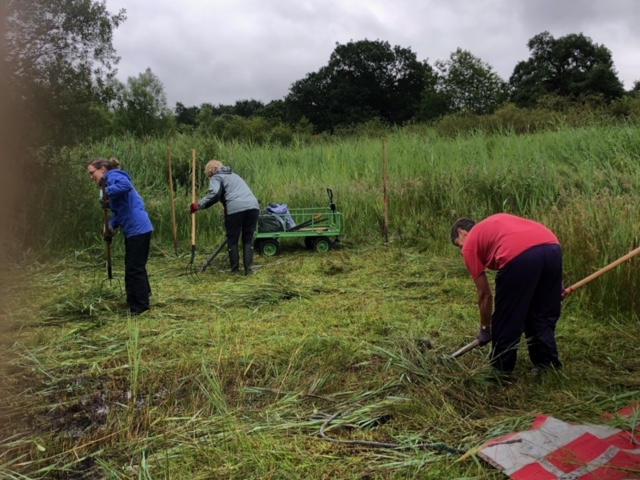
The task was to continue from where the previous working party had left off, to prepare a part of Pit Common for its conversion into a wildflower-rich meadow. This involved mowing the long grass, raking off the result, and digging out the many pernicious weeds in order to give the soon to be scattered wildflower seeds the best chance of germinating and thriving. They were unsure whether they had created a crazy golf course or whether a rampant were-rabbit or were-mole had been let loose:

While some were digging up those pernicious weeds, others were being equally active in raking the cut grass into long windrows, before dumping them at the edge of the site.

Once the main bit of mowing was done, the chance was also taken to do some of the path leading uphill from The Pit.

Despite the heat, it was good to see so many willing helpers, including new recruit Nina. At refreshment time they did a quick show of hands of those happy for Margaret to supply tea and coffee again next time, and it was carried unanimously. So to celebrate they cracked open a pack of ginger nuts - like the good old days!

Team Leader Margaret led by example in terms of enthusiasm, if not equipment care - she was the superwoman who broke a spade: she doesn’t know her own strength!

Here is her message of thanks:

I can't thank you enough for turning out on what must be the hottest day of the year. I don't know about you but I have only just cooled down. An amazing job was done by you all, not wanting to steal Duncan’s thunder but it rather reminds me of the film The Curse of The Were-Rabbit.  We have now fenced off the area to prevent broken ankles.

The rest of the pit grass looks amazing and perhaps Aaron will let us spread green hay without having to remove any grass in the hope that some of the seeds will take.

I am hopeful that by this time next year we will begin to see the fruits of our labours with more wildflowers and many more butterflies, moths and insects.

Thank you and we look forward to seeing you on the 1st of August back on the SSSI. It will be our pleasure to offer you refreshments as a small token of our appreciation.

Margaret and the team leaders.


As is usual at this time of year the vegetation on the five Commons is also putting in some serious effort, and growing apace: they’re all well worth a visit if you haven’t been recently.  Already a couple of un-scheduled work sessions have been needed to make sure the boardwalk is clear, but everything else is of course left to its own devices at this stage. If you need some tranquillity to take you away, if only briefly, from the mad time in which we find ourselves, I find pausing in the shade on the bridge over the Beck, half-way along the boardwalk, does wonders for me, and it just might for you too.

Two plants have been spotted that are not regularly recorded here. The Bee Orchid is a first record for the Common itself, although a neighbour has had them grace his garden for several years…

… and the Twayblade.

Birds continue to predominate on the sightings board, and it has been good to hear two reed warblers singing. Sadly, it is now several years since we have recorded a sedge warbler doing the same, and I am sad that I have not heard my favourite willow warbler, which typifies the sound of summer for me. Butterflies seem to be doing quite well: Red Admirals were unusually numerous a few weeks ago, and now we’re getting plenty of Speckled Wood, Meadow Brown and Ringlets. Today I saw my first Gatekeeper of the year, at the Warren Road end of the boardwalk. The sightings board has already clocked up almost 250 records this year, and that excludes the alpacas, dogs and rather dubious dinosaur ones!


Monday, 5 July 2021

13 volunteers (with no dog) went to mow a meadow

 Your usual correspondent having a good excuse to avoid the rain on 1st July, this posting is necessarily brief. Having less watertight excuses, 13 people, including two first-timers Janet and Bob, did brave the less-than-summery downpour to work at Pit Common. As Team Leader Margaret explains below in her message of thanks, the task was to prepare the overgrwon grass for its new role as a wildlflower meadow. Handling long soaking wet grass can't have been much fun, so I can't say I was too sad to miss it. 

Here's Margaret's message:

Thank you to the 13 people who braved the drizzle to work at the pit.

This is a new project for us. Since NWT took over we have left the pit uncut apart from paths to the sign and benches. We would like to develop the grass area into a more diverse area by introducing wildflowers.This will attract more insects and birds and hopefully humans. Unfortunately to produce a meadow is at first quite hard work, but they are relatively easy to maintain.

Today we did the first stage by doing what is called a conservation cut. This is to cut the long grass and remove it. Something we are very good at on the SSSI!  We had grizzly back for the first time and it cut some of it well but due to the damp grass and the thickness some of it remained uncut making it very difficult to rake up. So I am particularly grateful to you all for persisting.
The next stage is to cut it all again in about two weeks and again remove the cut grass. Grizzly should cope better. We are then asked to remove the persistent weeds and 30-50% of the grass and topsoil. Kevin is going to ask George if they have a turf cutter. I do not intend to do the whole area in one season, just the triangle as you enter.

If you would like to help again I am going to run another working party on Sunday 18th July. I fully understand that this task is not everyones cup of tea. 9.00 start.

The first working party on the SSSI starts on Sunday 1st August at 9.00.

Thank you again for your help and hopefully we will have the beginnings of a colourful grass meadow  next year for us all to enjoy.

Margaret

And here are a few photos to illustrate the job. Looking forward to the next stage!


Tuesday, 15 June 2021

Extreme weeding – part two


Just like buses, this blog arrives in clusters. After a break of months, last week we reported on the working party that pulled up bag-loads of Himalayan Balsam and trimmed the boardwalk edges, and now, already, we can report on a working party that pulled up bag-loads of Alder seedlings, and trimmed the boardwalk edges.

Another sunny morning saw 13 volunteers arrive, some perhaps whistling a merry tune with a spring in their step, such was the cheerful nature of the day. Two of those, Carolyn and Mike, were with us for the first time, so let’s hope they found it an enjoyable experience.

Of those intrepid 13, nine toiled in the noisome swamp intriguingly known as Area X, seeking to resist the inexorable March of the Alders by plucking out seedlings very close to the ground. Lacking only the iconic pointed hats, they compared themselves to working in a paddy field.

The medical benefit of good spinal flexion was perhaps offset by the inevitable backache induced, so other stretching exercises were necessary to relieve it. Bags were filled – a minimum of nine presumably, and tipped onto a new dumping site, to be covered with black plastic to prevent them re-sprouting.


Meanwhile four other doughty workers were busy completing the trimming of the boardwalk edges. Two brush cutter operators operated brush cutters, while two broom operators operated brooms. (Incidentally, why do you brush a boardwalk, or any other surface, but not broom it?)

It’s actually quite an achievement to complete this task in two sessions, and it represents a lot of hard physical effort.

Brushing (or brooming if you prefer) is also hard work, let me tell you. It’s no good just sweeping the cut stuff off to the side, it needs pushing together and hoiking off to a dump site so it can rot down in the time-honoured fashion. It’s a skill, no question. And it makes you hot.

Here is Team Leader Margaret’s message of thanks:

Thank you so much to the thirteen volunteers who came this morning. Fortunately for the alder pullers it was not so hot and a tremendous number of little seedlings got extracted thanks to every bent back. It will save us so much work later.

I think the brush cutters did not notice the cooler weather judging by the sweaty brows. Well done chaps, it has made it much easier to traverse the boardwalk and will be appreciated by all.

We will be sending out the dates for the new cutting season very soon, as well as opportunities to help make a wildflower meadow at the pit.

Thanks again.

Margaret.


We work on the Common because we care about it as a special place in our own back yard, and are grateful for the huge amount of support we receive from the local community, as well as NWT, on whose behalf we do the work. This was also the case from Southrepps Parish Council, the previous owners of the land. It is perhaps inevitable that sometimes what we do is not welcomed by everyone, but it should be stressed that we are helping to look after a statutorily protected Site of Special Scientific Interest, and the way that has to be done is laid down by Natural England, with the intention of providing the best possible return for nature. As always with conservation work, some of the benefits are quickly apparent, whilst others take years to be fully realised: the beauty of this place is that the range of different habitats provide both the annual joy of the revitalisation of familiar sections, as well as the satisfaction of watching other areas gradually return from an unsatisfactory condition of little value to wildlife, to one to be truly proud of.

Duncan


Thursday, 10 June 2021

Extreme weeding


Even though I’m not one, lacking the necessary qualification, the Team Leaders were kind enough to include me in their recent suitably distanced outdoor meeting to discuss plans for the next few months of volunteering on the Common – all things being equal. I confess to being briefly distracted by an overhead Buzzard (Buteo buteo), and as the meeting broke up a speeding bird of prey was spotted by several of us. It was only a fleeting glimpse, but its speed and the shape of its wings suggested it was probably a Hobby (Falco subbuteo). The keen-eyed amongst you will have noticed the similarity in the scientific names of these two raptors, and that’s because subbuteo means ‘smaller than buzzard’. That’s not very precise really, considering lots of birds are smaller than a buzzard, and the hobby is not even another hawk: it’s a falcon, smaller than a peregrine falcon as it happens, so it’s a shame its name is not subperegrinus, but what do I know?

Something I did know and wanted to pass on to my colleagues, was why the table-top football game Subbuteo was so named, but sadly, at the moment I was going to reveal it to an enthralled audience of the two who had failed to escape quickly enough, I discovered I could not remember the reason. Mark Cocker’s monumental ‘Birds Britannica’ came to the rescue once I found my way home, so the story is here related for your edification, as well as for any Team Leader who has persevered this far with this drivel. It seems that the person who invented the game in 1948 was called Peter Adolph. He, quite properly, was a keen birdwatcher, and wanted to trademark his invention ‘The Hobby’ after his childhood favourite bird of prey. The Powers That Be rejected this application, so he had another crack at it using the second part of the bird’s scientific binomial. Do people still play Subbuteo? I suspect some probably do, and maybe even form vast intercontinental super-leagues, the activities of which are only constrained by the current international travel ‘ban’. Strange to think that the game to which they are so devoted has a name which translated means only ‘smaller than a buzzard’.

Several years ago I managed to take a photo of one of these wonderful little falcons as it flew over the Common:


At our meeting it was decided that we need to start work on removing the emerging Himalayan Balsam and Alders, so the agreement of NWT was sought. They advised that before we could be confident of starting that job, we should try to determine if there were any nesting birds we must not disturb, so a couple of us carried out a survey of the relevant areas. Apart from one patch of willow scrub we were satisfied that the planned work for this month would not cause problems. It was pleasing to see that our iconic Bogbean plant is coming up in good numbers, although the Cotton Grass is so far looking rather thin.


That was something of a digression: here’s what happened on our first working party since restrictions have been eased.

The day before 10th June had been particularly hot and sunny; great for many purposes, but not especially for hard physical labour. As it happened, the weather had changed for the cooler and cloudier for our session; still quite warm enough thanks, but not too bad. The group of nine was split into two, five working on trimming back the edges of the boardwalk down from Warren Road…

… with the other four hunting and removing Himalayan Balsam, suitably dressed to protect themselves against stinging nettles and the possibility of deer-distributed ticks.

The boardwalk work is particularly arduous. Working the brush cutters is tough, but so is brushing up the resulting material and removing it from the scene.

After an hour or so of such hard toil we were ready for a break, so here’s the traditional photo:


Here’s the message of thanks from the day’s Team Leader:

Thank you to the nine volunteers who came to our first working party of 2021. It was great to be back. I had expected the Balsam to have grown faster in the heat and damp but unfortunately the nettles had grown faster which made for a 'stinging' experience. Well done to the boardwalk team who have completed edge clearance on two thirds of the boardwalk making it easier to walk. We have done this earlier than usual this year so we will see how that goes.

If anyone wishes to join us next Tuesday it will be more boardwalk clearance and pulling up of alders and Himalayan Balsam: meet by Foxes Beck bridge at 9.30.

Thanks again.

Margaret

The next session will be on 15th June, when we will be excited to welcome some new recruits to the cause. No doubt more edge trimming will be on the agenda, alongside more Himalayan Balsam and Alder sapling removal.

Anyone who has walked around the Commons recently will have enjoyed the sight of them waking up again. Here is School Common, with Broom in resplendent flower.

At this time of year the varying shades of green on the central area of the Common are particularly lovely. In addition to Bogbean, orchids are in flower, along with lots of Ragged Robin and many of our other signature plants.

The dappled shade at the bridge over Fox’s Beck is a great place to pause and take in the peaceful scene, and never more so now. Thankfully, it never seems to run dry, and except after heavy rain, is always crystal clear.


It’s good to be back!


Sunday, 28 February 2021

Nature flouts lockdown shock


We might still be enduring our third lockdown, albeit with a prime ministerial roadmap out of it, and punctured arms, to give us some hope that an end is in sight (unless there are diversions on the road, or the Satnav is up the spout). Nature however recognises no such restrictions, and is going full tilt at the only thing it knows. Responding to the stimuli of increasing day lengths and wildly fluctuating temperatures, it has decreed that Spring is under way. Last Spring many people discovered nature as if for the first time, so this year there will be the welcome feeling of recognition of old or perhaps newly made friends reappearing.

Speaking of which, today’s weather was again glorious, after a cold night, and a walk across the Common yielded 17 bird species. These included the singing of my first chiffchaff of the year (presumably one of the growing number that find it possible to stay all winter, although our cold snap will have come as a shock). Also singing were chaffinch, dunnock, goldcrest (again, how does something so tiny survive freezing days and nights?), great tit, robin and wren. The highlight for me was a female sparrowhawk soaring above the sewage works at the end of Warren Road, where a grey wagtail had been spotted earlier in the day. Hazel catkins were dangling in the light breeze…

Just to prove winter’s not all over yet, siskins were twittering high in the alders beside Fox’s Beck, not having felt the need to move on to summer quarters yet, and Snowdrops are still in flower.

A garden very close to School Common, benefitting from the unstoppable Beck running through it, has had some exciting birds visit it during the harsh winter weather. Four snipe, two woodcock, one water rail, two little egrets, two herons and most excitingly a great white egret all put in an appearance. The record for the great white egret is a wonderful first! It dropped in on Valentine’s Day and posed for its portrait to be taken by a remote camera. They have the most remarkable long necks that look as though it’s possible to put a knot in them (not the knot that's a small wader famous for its massive murmurations - that would be silly), although swallowing fish would then be tricky. No doubt they’re careful to avoid that.

The lockdown has of course made a mess of our cutting programme. We had begun to cut part of the main area of reedbed just before everything ground to a halt, and it looks very much as if the remainder will have to wait until next winter. Here’s how it looks at the moment.

It is scheduled to be cut every four years, so leaving two thirds of that section for a fifth year might make for tough working when we are finally able to deal with it. Mind you, if we were working on it now, we would get very wet!

We have had word from our NWT warden that some limited working groups might be possible from the end of March, but that will probably be too late for that particular job. However, it’s encouraging that we might be able to resume some working if the ‘roadmap’ doesn’t take a wrong turn. Meanwhile, nature will be working full time, and if you can get to the Common for a spot of socially distanced exercise, I do hope you enjoy it.