Monday, 5 February 2024

Spring in the air

Spring in the air? Most of us are knocking on a bit (indeed, there’s a fair sprinkling of septuagenarians in our doughty group), so any suggestion of springing is rather out of the question. As for the season however, the unfashionably early spring weather is certainly leading a lot of plants and birds to wake up. The snowdrops are looking great, and justifying the earlier work to keep this section on the edge of Bradfield Road clear in readiness for their display.

I have recently listened to a lovely podcast on BBC Sounds, about a visit to the reed cutters on Cley Marshes. The Bishop family have been cutting reeds there every winter for several generations, with very little change to the tools and methods used. As well as hearing about the current line-up, there was also a short section focussing on the management of the NWT reserve; which of course shares our warden George with us. The item is called Reed cutting at Cley, and it’s in the Open Country podcast. Since we share a passion for cutting reeds, it’s well worth a listen.

Speaking of weather, there had been a good dry spell, including the couple of days after the pre-cut of reeds ready for our attention today. Unkindly, it rained the evening before our work session, meaning that the piles of cut reed we were presented with were soggy again – just like last time. In fact, it was surprising just how much boggier the whole area had become in the last fortnight.

As soon as the drag sheets are laid out the happy throng of volunteers (20 again this time) set to with a will and a pitchfork; here they go.


But before the loaded sheets can be moved, the vital winch crew must get the blessed machine in place and running; that’s what these three are up to.

Regular (or even irregular) readers of these posts will be only too aware of the tendency of those at the winching end of the operation to burst into song, usually led by the redoubtable Noel. Today was exceptional, in that a quartet of rich male voices formed, including your own, your very own, correspondent. For reasons already unclear, our concert began with Waterloo Sunset, originally by the Kinks: a little later a rousing rendition of L-O-L-A Lola rounded off the performance. A stray remark of how summery the temperature felt led us nicely into the hits of The Small Faces and Mungo Jerry. We then, for no apparent reason, meandered into a bit of Oliver! The Musical, with the risk, thankfully averted, of a longer diversion into Songs from the Shows. The rest of the work party, safely out of earshot, don’t know what they missed!

Summer it might not yet be, but it was definitely milder than last time, and within 15 minutes the layers were coming off. Thank you Nature for providing a coat stand, albeit one reminiscent to at least one of us as a gamekeeper’s gibbet, looking as it did like a lot of strung-up crows. These of course were intended to warn “vermin” about their fate if the keeper saw them: in this case it could perhaps serve as a warning to unwary folk inclined to join us in our muddy cavorting.

Team Leader Julie was busy raking up as much as possible of the wet material left behind last time.

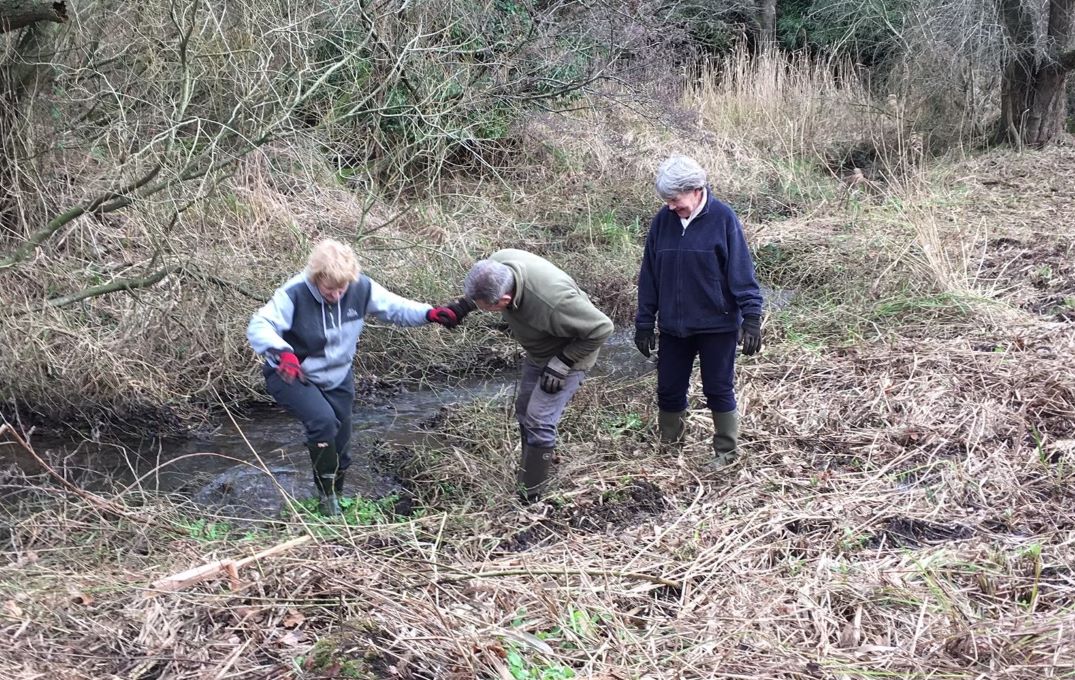
A useful incidental task in this area is to keep the watercourses heading towards the Beck clear.

 The half-time break arrived to general relief.

It was a relief tempered somewhat by the loss of the majority of the biscuits in the muddy morass. In Sheila’s absence, we blamed it on the Catering B team! But it didn’t entirely inhibit those for whom Custard Creams are so desirable; they’re alright if they don’t get too soggy

Then the fear was that a pile of uneaten biscuits beside the boardwalk would not be considered inedible by passing dogs, with the risk of enraging their owners, so it was decided to submerge them. (I don’t think it will present much of a challenge to Basil and his ilk though.)

The old yellow drag sheets were brought out of hibernation for some of the older, wet and heavy material to be piled onto, so that they could then be laboriously dragged to the main sheets for winching the considerable distance to the dumping site.


At first I thought some giant amphibious moles had been at work, but their molehills turned out to be piles of almost immovable vegetation.

Almost immovable, but not quite. Not for the first time, thank goodness for that winch!

While all this forking and winching was going on, Brian was busy with the brush cutter clearing dead stuff away near the car park.

He was later joined by others to help keep the Beck clear.


By the end of the session there were still three fully loaded sheets to winch away. This will be done by a small team next Saturday, all being well.

Otherwise, Area F is cleared and our reed clearance duties completed for this season.

What a view from the car park now!! 


Here is Team Leader Margaret’s message of thanks:

Hello all you wonderful people.

Another amazing morning's work. We have now completed the cutting programme for this season. Thanks to the conditions underfoot it was another morning of hard graft and we are extremely grateful for your efforts. We hope it gives you pleasure as you stroll along the boardwalk. We still have three sheets to pull, those of you who said that they would be willing to help with this task, we shall meet at the container at 10.00 next Saturday. JH suggests it takes 10-15 minutes per pull; so it should only take an hour. If it is pouring with rain we will cancel.

We will contact George Baldock our warden and see if there are any other tasks he wants doing, and let you know in good time if we will be holding a working party in two weeks’ time.

Many thanks again.

Margaret (for the team leaders)

Sunday, 21 January 2024

Volunteers beetling away again

 There are apparently more than 400,000 species of beetles in the world: some are a nuisance to humanity, but all are doing valuable work in their own ecosystems. Amongst the most useful and visible are the dung beetles, and a recent article in The Guardian highlighted research showing that male and female South African spider dung beetles coordinate to roll balls of, well, dung. It says in the article that “They don’t know where they’re going, but they can still coordinate to move the object together.” These are thought to be the only example of animals other than humans working together without knowing an object’s destination. In other beetles that roll balls in pairs, the females tend to hitch a ride on the balls of dung, or walk behind their ball-rolling mate (presumably holding a scented hankie to their little nostrils, in the same way as can be necessary at the moment when walking past huge mountains of pungently decaying manure waiting to be spread on the local fields.)

This surprising research was drawn to the attention of your correspondent by a fellow volunteer, who thought it could describe alternate Sunday mornings on the Common to a tee. I for one decline to comment.

Speaking of your usual correspondent, once again I was absent for the first half of today’s working party. The reason was of course entirely legitimate, but it was a lucky coincidence that my eventual arrival was as the tea break was starting, so that I could enjoy the warm greeting of my fellow beetles volunteers. The warmth of that greeting was perhaps tempered by my initial surprise that the job wasn’t yet finished, but nonetheless the cup that warms and a biscuit still came my way.

The pre-cut crew had of course been busy a few days before, leaving the area looking like this to greet the initial 18 volunteers.

Since I was absent for the first hour, I am grateful to Team Leader Julie for her photos and account of what took place, on what was very soggy ground. As I found out, if you stood still too long you felt a sinking feeling, there were treacherous streamlets heading for the Beck, and keeping your balance was quite tricky (although nobody actually fell over).

The first problem to deal with was unfolding the still-frozen drag sheets. And then, although it had only recently been cut and not rained on, the material to be shifted was particularly heavy and awkward.

Then it was on with the usual tasks:

Forking the cut material onto the drag sheets

Escorting the sheets being winched to the dump site


Just in time for my arrival, there was the traditional gathering for coffee

At break-time the pitchforks are set aside, and don’t these ones look pleased, giving us their thumbs up?

We’re a multi-talented and multi-skilled bunch, as is obvious for all to see. It’s not often you find a glove puppeteer on a boggy fen, but it can happen.

Every so often a long straggly stem, or root, or something else the botanists would know the name of would interfere with the smooth lifting of cut reeds. Dire warnings were issued by the Wise Woman of the group (who had watched too many horror films in her youth) that these were manifestations of something evil on the benighted site, and we should all watch out. She was a bit better after a little lie down – but who knows if she was right…? (Team Leader Margaret did later take a tumble in the storage container – just saying.)

We like to show where the cut stuff gets dumped, and once again the winch and tipping out crews had come up with an impressive pile (not a medical term, you understand).

When the work was over, and people were wending their weary way home, those who needed their boots in sparkling condition for, presumably, future social engagements made their way down to the Beck for a spot of hazardous welly washing. This, as Rita discovered last time, is fraught with danger, but nothing daunted she did it again.

Brian made sure the job was a good ‘un before letting her back out.

Here’s how the area looks now, with one section left to deal with.


Here is Team Leader Margaret’s message of thanks:

A very heartfelt thank you, to the 19 people who came today. It was hard going with the heavy wet conditions under foot. As always you all rose admirably to the task. It is great to walk across the bridge and see right across to the bench, a view seen only every four years. It will also make hunting down the Himalayan balsam easier. Roll on May!

So take your well-earned rest this afternoon and hopefully see you, same time, same place in two weeks.

For those who saw my inelegant fall, no damage done at all.

Thanks again.

Margaret (for the team leaders)

Sunday, 7 January 2024

A soggy start

 “Mud, mud, glorious mud” sang Flanders and Swann, but unlike their Hippopotami, the Southrepps Commons Volunteers feel that there is a limit to how much mud is enjoyable, and currently that limit has been exceeded. The Common acts as a massive sponge, for which we Southrepps folk must be very grateful, but there’s still plenty of water available in the surrounding district. The fields are waterlogged, the footpaths are quagmires, and the lanes are filthy, due in part to the churning up of the road edges by vehicles too wide for our Quiet Lanes. When you have a dog as absorbent as ours, it can become a little trying.

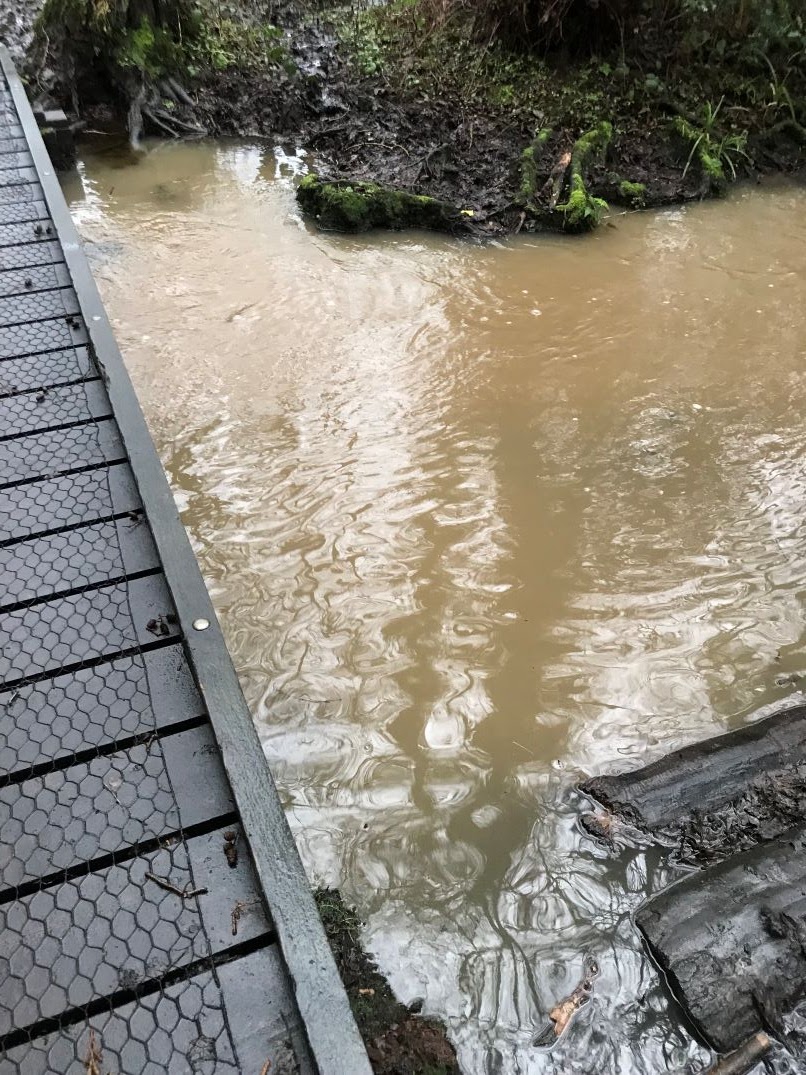
A couple of days ago, Jubilee Boardwalk was as flooded as I can remember it; towards the Lower Street end the water was almost level with the top of the boards.

And at the bridge over Fox’s Beck the usually clear stream was full of the mud that should be in the fields, and flowing fast.


So it was that this morning 22 volunteers arrived to do their bit for their local nature reserve. We’re always encouraged to dress for the conditions, but why nobody thought to bring a snorkel was disappointing. Your usual correspondent unwisely chose not to bring warm headgear either, but finding the nip in the air too much for his rather reduced locks to be able to provide adequate insulation, on came a particularly stylish hat intended for rainier conditions. This excited some comment: it seemed that all 21 of my fellow volunteers found it unaccountably risible. Only the wetness of the ground prevented many of them from rolling around clutching their aching sides. Their names have been noted, and retribution will surely follow in this blog…


On arrival, the first sight that greeted us was not encouraging: a short-cut pathway between the storage container and the area we were working in was particularly sodden, and a yellow tarpaulin did little to inspire confidence.

Further in, it was no better. Movement was fraught with jeopardy, but standing still brought on a sinking feeling.

Having negotiated the first deadly bog, laid out before us was the sight of material cut a few days earlier by the ‘pre-cut’ team. We could make a joke here about being half-cut, but perhaps not.

The previous working party was four weeks ago, and with the prospect of minced pies and other Christmas goodies on our minds we had left two fully loaded sheets there. They had waited patiently, absorbing vast quantities of the rain that fell unceasingly in that intervening period, and were of course particularly heavy to shift. Thank goodness for our splendid winch (and winch operators of course)!

With so many hands at work, it was tempting to load the sheets well, as each pull and tipping out took some time across a significant distance. Even so, there was ample opportunity for people to catch up with news of each other’s festive breaks – running the risk of cold feet however.


Along the way, Team Leader Margaret found time to replace two broken board on the boardwalk – an all-too-frequently required task these days.

The half-time break came, on possibly the only fairly dry spot of that soggy area. A matter in common for many of us was whether are hands had thawed out yet.

Having drained their cups, the assembled multitude attempted a world-record tower of cups, reminiscent of the ‘beer snakes’ at rowdy cricket grounds. (Ours wasn’t rowdy of course.)

As is customary, Noel found a comfy seat.

As we have frequently discussed, the said Noel is prone to bursting into song at the slightest provocation. This time someone must have mentioned this was a suitable place for the likes of us, and blow me if Noel was immediately giving us his rendering of “Somewhere (There’s a place for us)” from West Side Story. Perhaps by way of distracting him, I tried to remember who had had a hit with it in 1964, with a very exaggerated delivery. Long John Baldry was my guess, but it was actually P J Proby – look it up on Youtube. Noel favoured the Tom Waits version – look that up too. They put Noel’s performance into perspective, it’s fair to say.

As ever, tipping the loaded sheets out is hard work, although it’s far easier when the winch is used.


After two hours, we stopped. Team leader Julie also tends to be involved in the folding up of the drag sheets at the end of the session. Here she is clutching one. They’re quite heavy, so it was entertaining to see if the extra weight would cause her to sink in the mire. Happily, it didn’t, but it was interesting to see if it would.

Once we had finished it looks like this…

… but there’s enough left to take another couple of sessions before we’re completely finished.

Here is Team Leader Margaret’s message of thanks:

A very Happy  New Year  to you all.

What a cracking start we have got off to. 22 of us turned out this morning. As usual the amount we achieved surpassed expectations. The cut area looks magnificent. Despite very wet conditions underfoot everyone managed just to stay upright.

Thank you for your continued commitment to the maintenance of the Commons and hopefully we will see you in two weeks’ time. Do feel free to join us just for coffee and a chat at 11.00. We are always pleased to see old faces and new ones.

Margaret (on behalf of the team leaders)

And finally, it’s customary to wallow in statistics as well as mud at this time of year, so fill your boots:

As for our volunteering activities in 2023, 38 of us collectively put in 800 hours. There were 21 working parties, with an average attendance of 15. By far the biggest recipient of our efforts was the SSSI (i.e. the main common), clocking up just under 560 hours. The next most worked on area was Pit Common, receiving 74.5 hours of our attention. The summertime activity of removing Himalayan Balsam took up a further 69.5 hours.

We reported exactly 500 sightings of plants and wildlife to NWT in 2023, mostly via the whiteboard at the Lower Street entrance to the boardwalk. 177 species were represented, including 68 flowering plants, 63 birds, 15 butterflies, and 11 mammals.

The other day I heard a Mistle thrush singing. That’s not unusual at this time of year, but it was still a pleasure to hear an early portent of Spring. Unlike most mornings recently, it was gloriously sunny and there was hardly any wind. Mistle thrushes also go by the name ‘Stormcock’ to their friends, due to their tendency to sing in loud and wild weather. On this occasion I had just endured the paralysing din of circling warplanes, so I wondered if that might be what triggered the thrush into shouting back. The couple of thousand geese I saw flying overhead the day before might perhaps have been disturbed in the same way.