Sunday, 26 September 2021

Rickles or Windrows; you decide.

The last two weeks have again seen a great deal of voluntary work carried out on our commons; 44 ¼ hours have been clocked up between working parties! This includes a lot of ‘extra-curricular’ activity, mainly in order to be able to meet Natural England’s changed timescales which require a lot of the work to be completed within a short window between the end of summer and not very far into autumn.

First up was work at Pit Common on the 18th to cut back the vegetation around the pond – including the stuff that had grown up alongside the road. This had made it difficult to see the Pit itself, and it came as a surprise to your correspondent to realise just how much it has been invaded by the dreaded Crassula; a highly invasive and pernicious pond weed that belongs in New Zealand, where presumably there are things that keep it in check by eating it. Unfortunately, it seems to have no natural predators here, and once it infests an area it is extremely hard to eradicate.

Here's the view before the job:

And after:

Six volunteers got themselves very hot brush cutting and clearing away the resulting debris.

The next event was on Tuesday 21st, when the top portion of Area B was cut. The two areas adjacent to Warren Road, divided by the boardwalk, are meant to be cut on alternate years, but this part has become so invaded by reeds, bracken, Golden Rod and Michaelmas Daisies that it has been decided that an annual cut is required. This also had to be completed by the end of the month, but it was too much for us to clear away alongside the regular work, so on Friday 24th George, our NWT warden, came to do that, accompanied by a couple of volunteers who work with him at Cley. Team Leader Margaret and two other SCV stalwarts also helped out, logging another 5 ½ hours between them.

This Shield Bug also decided to put in an appearance

Here’s how the place looked after this Herculean effort

Two days later Team Leaders Margaret and Julie were out again, putting in another 5 ½ hours between them doing more back-breaking hand cutting of reeds on the wildflower-rich central area G, which Grizzly has finished with this year.

This arduous task is all about removing reeds from an area important for a range of flowering plants, as well as the mosses and liverworts that so excite the scientists. Perhaps none are lovelier than the Grass of Parnassus, beautifully captured by Julie:


The day before the main Sunday working party saw three people cutting more of Area A, followed by Team Leader Kevin going on to put in another 4 ¼ hours at The Pit. This ‘pre-cut’ was to provide a lot of material for the main group of volunteers to work on from the start of the session. The pressure is on to complete cutting the entire area by the end of the month, so even though we cannot clear it all by then, it should at least all be cut.

16 splendid volunteers arrived for Sunday’s main event on 26th. I’m not sure about the mellow fruitfulness, but Keats’s autumnal mists were in evidence when I woke with a scream not long enough after the post-equinoxial dawn. Not until late afternoon did the sun break through, but at least it refrained from cooking us at our labours on the famed Area A. Mind you, it was very humid, so rest assured, we still suffered.

Team Leader Margaret explained to us that the plan this time was not to solely concentrate on forking the cut vegetation onto the drag sheets, as there was no way it could all be shifted in the two-hour session. Instead, we were to also create ‘rickles’. These are defined as “loosely piled or disorganized heaps”, which sums us up pretty well I think. There was long and learned debate as to whether they can also be called windrows, which according to my dictionary are “long lines of raked hay drying in the wind”. They’re not exactly hay for equine consumption, but they are comprised mostly of a rich profusion of different grass species and other super plants, so ‘windrow’ seems equally acceptable. Here’s what they look like:

A recent appeal for more people to be trained in operating Grizzly yielded a willing volunteer, in the shape of recently recruited Dave. Under John’s expert and very experienced guidance he took to the skill very well; something that looks far too difficult for your correspondent to attempt.


I think we all take pleasure and pride in what we do on NWT’s behalf on our Common, and the winch team enjoys making ever more refinements to the process of moving a laden sheet across wet ground to be tipped out at the edge of the area being worked on. Your correspondent went so far as to boastfully say our work was slick, and winchman Noel has now adopted that has his middle name, so carry on Slick!

Not to be outdone by Friday’s Shield Bug, this six-legged spider showed up. It didn’t seem to walk with a limp, but having four legs on one side and being deficient on the other to the tune of two can’t be easy, so well done the plucky little arachnid!

Here is Team Leader Margaret’s message of thanks:

Hello all.

Once again I find that ‘thank you’ is really very inadequate for all the work you do. We have made excellent progress on clearing area A. The hope is that the rickles will dry and be lighter to lift in two weeks and that the other material can then be made into further rickles for later removal. We have several weeks of work still to do.

Thank you too to Dave who had his first session with grizzly and an excellent student he was too.

The pit often gets overlooked but there is always someone beavering away to maintain the area and cut the grass so thanks to the pit team.

We have also received some lovely comments from users of the commons who so appreciate the work you all do.

I saw my first skein of geese this morning so Autumn is upon us.

Thanks

Margaret for the team leaders

Sunday, 12 September 2021

Area A gets its trim


This being the relevant time of year, much of the countryside looks like it has had a haircut. Included in this must be our Common, which according to the decrees of Natural England has to be trimmed in line with a strict schedule. The central area having had its cut (except for a small remaining patch waiting until the end of the month), the section next up for the chop is the enigmatically named Area A. This is the bit beside Warren Road between Lower Street and the boardwalk, and is cut every other year, alternating with the section the other side of the boardwalk, which is unsurprisingly called Area B.

With two summers to grow in, the heady mix of grasses and many other plant species take full advantage, and a fine old tangle is the result. This makes for hard work for the Grizzly mower, and even harder work for the un-grizzly mower operators. Three pioneers spent two hours each on Wednesday, performing the ‘pre-cut’ to ensure there was something for the volunteers to work on from the start of the Sunday work session. Those three heroes are to be applauded, for the weather was hot and humid; something for which this summer has not hitherto been noted.

Here’s how it was when they left it:

On Saturday, Julie and Margaret continued the back-aching task of cutting reeds on the central part of the Common (Area G for your future reference). This allows for the required control of the spread of reeds into that area, whilst giving the special flowering plants growing there more time in which to flower and set seed before the final sweep of the mower. They might feel mad as hatters standing crouched over for an hour and half taking individual reeds out….but these beautiful Devil’s Bit Scabious and Grass of Parnassus flowers illustrate why they do it…


Sunday dawned bright, and all too early for my taste. The weather was initially pleasantly fresh, although as the morning wore on and the work became heavy, it did get a bit too warm for total comfort. Nonetheless, we applied ourselves to the task very much in the manner of teenage tennis prodigies, and in no time at all (well, two hours actually), a vast swathe of grass was mown and moved to the growing pile at the edge of the site.

It’s not all pitchforks and similar bucolic implements of course; machinery also figures large in our work. First and foremost, there’s the Grizzly mower – or in this case, where’s the Grizzly? As can be seen, the vegetation is tall and thick, unlike the driver, who is tall and thin.

Then there’s the vital winch. The crack winch team have discovered that it works best if the proper respect is shown, so bowing to it before asking it to pull anything is always a good idea.

Turning your back on it and pretending it’s not there rarely has the same effect…

Readers concerned about the fate of the little green trolley will be relieved to learn that it has been returned to service, having had the tender attention of the SCV Maintenance Department. John might not have just done what I would have done, and hit it with the biggest hammer he could find, but whatever engineering technique he employed, the result was that the vehicle can once again be steered along the boardwalk without falling off it, and that’s a considerable benefit. We also found that having tyres capable of retaining air makes it much easier to move; the trick was to slow it down on the slopes, so brakes might be the next request.

The vegetation will keep growing at this time of year, doing its best to make the boardwalk impassable, so Brush Cutter Brian was very usefully employed clearing the way. That’s a tough job, as is the sweeping of the trimmings off the boardwalk, ably performed by Dave; a more accomplished sweeper than can currently be found in the ranks of his beloved Norwich City it seems!

Half time came along not a moment too soon, as it was half way through the session. We took advantage of a hard surface for once to stand about on, enjoying tea, coffee and chocolate Bourbon biscuits.

Team Leader Julie spent a lot of time on her mud face pack, through being bent double clearing blockages from the ditch running down to the Beck alongside the western edge of the area. We think she enjoyed it, but her reply to our question was a bit ambiguous.

The nature of the vegetation in that area is that there is a lot of it; heavy and tangled, and still full of sap. Even more than the reed bed, this makes for especially hard work, and creates a lot of stuff to be moved. By the end of the session, an awful lot had been moved, but some was still there. It’s not something we like to do, but this time we left some piles, waiting for our attention next time.


Here is the Team Leaders’ message of thanks:

Once again I wish to thank all our volunteers for all the work you do on the Commons. Today you cheerfully gave up your time to help maintain the SSSI, it was hard hot work but you all got stuck in and achieved a huge amount.

Every two weeks our other unsung heroes of the pit mow the grass area, often in very hot conditions for the benefit of the whole village. Thank you.

It is only through your generosity of time and effort that we can all enjoy the Commons, not just the humans but getting that delicate balance for all the flora and fauna.

Margaret and all the team leaders


Monday, 30 August 2021

Pumped up and ready for action


Faithful followers of this Blog, if indeed there are any, may remember that last time your usual correspondent was almost as deflated as the tyre on our little green cart that had unreasonably burst following the injection of some (perhaps excessive?) much-needed air. Careful examination of the other tyres on that vital vehicle by the Southrepps Commons Volunteers Maintenance Department (John and John) revealed that the three remaining tyres were not far away from going pop too. You won’t be surprised to learn that replacements of such specialist items are hard to track down, but after much research a set of four was procured with the clock ticking; we desperately needed the trolley to be back in use at the next session. After monumental struggles the new tyres were fitted, and at the start of this latest working party the tools were loaded onto the waiting trolley and off it trundled. It trundled very well, the air in the tyres making light work of movement. Sadly, it had forgotten how to steer; it was again useless. The Maintenance Department investigated, and discovered that something important in the sophisticated mechanism had become bent, or broken; not requiring more air or blu-tack it had gone beyond my competence. So let’s hope the ability to control the direction it goes in can be restored in time for our next working party.

The task this time was to clear the grass and reeds from the smaller part of the central area (known as Area G) on the southern side of the boardwalk. Grizzly Driver John had cut the stuff a few days before, and reports that it had been so verdant that in carving out his first strip he lost his bearings. Classically, explorers wore pith helmets, but perhaps someone had taken his. Here’s how the site looked after his efforts.

This time 23 volunteers came along; seven more than the previous record for this season. As has been well documented, when visitors descend on your usual correspondent, he uses this as an excuse to skive off, often for a month, the better to recuperate. Team Leader Margaret is cut from different cloth however, and a visiting family of five accompanied her to the working party. Happily, they seemed to enjoy it, as did the rest of us. Here’s the busy and bucolic scene.

Such was the richness of our human resources, we had enough people to not only heap the drag sheets high and winch them to the dumping site, but also to clear up after the brush cutting crew, who cut brush with gusto. At this time of year the vegetation bordering the boardwalk does its best to grow across it and meet in the middle, which is not fun for anyone trying to use it, especially after heavy rain, so efforts to trim it back are essential.

Here they are again, with in the background two adventurers on the larger side of the boardwalk, hunting down and eliminating reeds one by one, in order to delay the need for mowing so that the flowering plants can get on with flowering.

The well-renowned winch crew were at their astonishing best, hauling in sheet after sheet of heavily loaded material, and creating a mountain of vegetation ready to quietly decay over the next 12 months (I mean the vegetation of course).

Here they are examining the winch, trying to work out which way is up.

We were fortunate that the weather was almost ideal for this work: not too warm, no rain, and a breeze that was no more than pleasantly cooling. Nonetheless, when half time came and the refreshments were available, the field was abandoned.

Here is the obligatory group photo of refreshed volunteers.

A considerable spider was discovered on Team Leader Margaret’s back. It looks like a particularly well-fed Orb Web Garden Spider to me, but I am no arachnologist, so am ready to stand corrected. Rest assured, the spider was safely returned to the ground, and there was no unseemly shrieking (spiders don't shriek).

The area concerned is not large, but even so, the amount of vegetation to be removed is considerable; it would be fascinating to know the weight of the amount we shifted. It usually takes a couple of sessions to complete the task, but with the turnout being so good, and a willingness to carry on working for a while past the official end time, the whole lot was cleared in one hit – something the old hands don’t remember being achieved previously. The old hands in this picture are smiling broadly because it’s the load they have been looking for all morning – the final one.

And these two ladies are either engaged in rolling up a drag sheet at the end of the session, or praying for that end to come.

Here’s how the area looked like at the end of the session, ready to start growing all over again.


Here is Team Leader Julie’s message of thanks:

Dear Volunteers

We hope that you are all keeping well.

We wanted to say a massive thankyou to today's volunteers for a great job done on the Central area to the rear of Chadwick Bench.

The area had been pre-cut along with a stretch on the other side of the boardwalk and this was all cleared. Everyone was so efficient at loading the reed onto the sheets we had a queue of them to be dragged and emptied - but it gave everyone a chance to stop and chat for a while! We ran slightly over the two-hour time allowed, so an extra thanks to everyone for staying to complete the task.  

As we had a good turn out today it allowed us to take a few people off to clear the boardwalk edges from the bench along to the Bradfield Road spur. So thanks also go to the operators of brushcutters, brooms, loppers and saws! We still have more to do on the edges but a good start was made today.

Finally, thanks go to the crazy ones that were hand weeding reed from the central area in front of the bench to allow the wildflowers to flourish.

A very productive work party today.

Regards, Julie (for the team leaders)


Sunday, 15 August 2021

Wildflower heaven, and the working party ends with a bang!

The supply of visitors to your usual correspondent having temporarily dried up, he has made a surprise return to the fold. So numerous are the newly recruited volunteers, half the assembled workers have no idea who he is. I have to tell you dear reader, he is the one responsible for this drivel.

Since the last posting of this blog, there has been a sharp uptick in the level of activity; our volunteers are back, looking after the best interests of the local birds and bees, beetles and butterflies, and of course the botanicals. The start date of Natural England’s cutting programme for the SSSI has now passed, and the first working parties are under our collective belt. On Friday 6th Team Leaders Julie and Margaret toiled away for a couple of hours in the central area, cutting four bagfuls of reeds by hand, in order to avoid the need for the mower to be used there, and thus protect the most prolific of the wild flowers which have not yet set seed.

It was warm work in high humidity, but then a heavy shower came along. Fortunately they were able to take shelter in the tool store, but then decided to remove some Himalayan Balsam plants that were encroaching into the reedbed – the now very wet reeds transferring much of their recently acquired rain onto the two plucky adventurers.

On Saturday 7th a significant milestone was reached, with the scattering of seeds on our embryo wildflower meadow at Pit Common. A lot of hard work had already been put into preparing the ground, by way of removing pernicious weeds like Dock and Hogweed, as well as removing a good proportion of the turf in the selected and roped-off section of the Common. More of that went on before the arrival of the seeds, which had been collected that morning by Aaron, NWT’s expert in these matters. He arrived in a car laden with newly mown plants, as well as a couple of buckets containing seeds mixed with sand. Here’s how the site looked during its preparation:

The loose seeds were scattered across the patch, and then the ‘green hay’ as it is known was strewn on top; the idea being that there will be many more seeds contained in it. Seeds in the mix included oxeye daisy, sulphur clover, field scabious, yellow rattle, cowslip, common bird’s-foot-trefoil and meadow vetchling. The yellow rattle is particularly useful, as it parasitises several grass species, weakening them enough to give other plants a chance to thrive. Passers-by will have been struck by the sight of seven people apparently doing some kind of primitive dance, as the hay was trodden down.

They will rightly have surmised that it was a rain dance, because a few hours later the heavens opened and considerable precipitation was the result. Here the dancers are, sheltering from the rain during a less extreme shower; don’t they look surprisingly cheerful?

In addition to the main section, a small patch at the far end of the site patronised by moles was also treated in the same way. Aaron has recommended a spring cut of the flower area in March with the ‘arisings’ removed, and then a cut in August/September after the seeds have set. These can then be used to gradually increase the wildflower area, using the same technique.

Here’s how the site looked after the ritual strewing was complete.

The next session was on Friday 13th when six brave souls fought their way through the reed to remove the Himalayan Balsam infesting both sides of the Beck on Area F, near the car park. As Team Leader Julie reports, “The reed and Balsam towered above all of us and after last night’s rain it was a very wet job! Luckily no one fell in the Beck though!


We were pleased to see that there was considerably less balsam than last year in this area so our effortsare not in vain.”

Nonetheless, a reasonable haul was evident by the end. Here are those snazzy braces again, with Team Leader Kevin modelling his new plastic skirt for good measure; the voluminous look is in this year! 


15 volunteers (including four recently recruited ones) arrived in the late summer but early morning sunshine on Sunday 15th, eager to squelch around in the mud whilst clearing the recently cut reed and grass from the central area of the Common, so evocatively named Area G.

As usual, the work required nifty use of the pitchfork, heaving the heavy wet stuff onto drag sheets for winching to the dump site at the edge of the area.


Team Leader Julie wielded her camera to artistic effect, spotting the moment when it seemed a spotlight had picked out Andrew in mid-dance.

Now we are back with refreshments allowed, at half-time we gathered together for the customary group photo; not in the reeds I hasten to add, but on the cunningly well-hidden boardwalk.

We often focus on fashion in this blog; with Team Leader Kevin and his snazzy braces absent, the day was saved by this fetching matching ensemble, created by Norfolk Wildlife Trust and modelled by Pauline and Richard.

Neither of the two photographers on duty remembered to take a shot of the area once our work was done, but this one gives a reasonable impression of what it looks like now, although you must try to imagine it without the quartet of volunteers.

A lot of the equipment we use is transported from its store to close to where it’s needed on a little green trolley. This has a wheel at each corner, theoretically making it easier to pull to where it is wanted. As it seemed harder going than usual on its way back to the tool store, we noticed that the pneumatic tyres lacked an adequate amount of the requisite component; air. Your correspondent sought to rectify the situation by using the foot pump he so wisely carries in his car, and started pumping the tyres from 0 to the correct pressure as embossed on the tyre wall. All went well for the first tyre, and indeed it seemed it had for the second, until with an almighty bang, it burst! The evidence is presented for all to see:

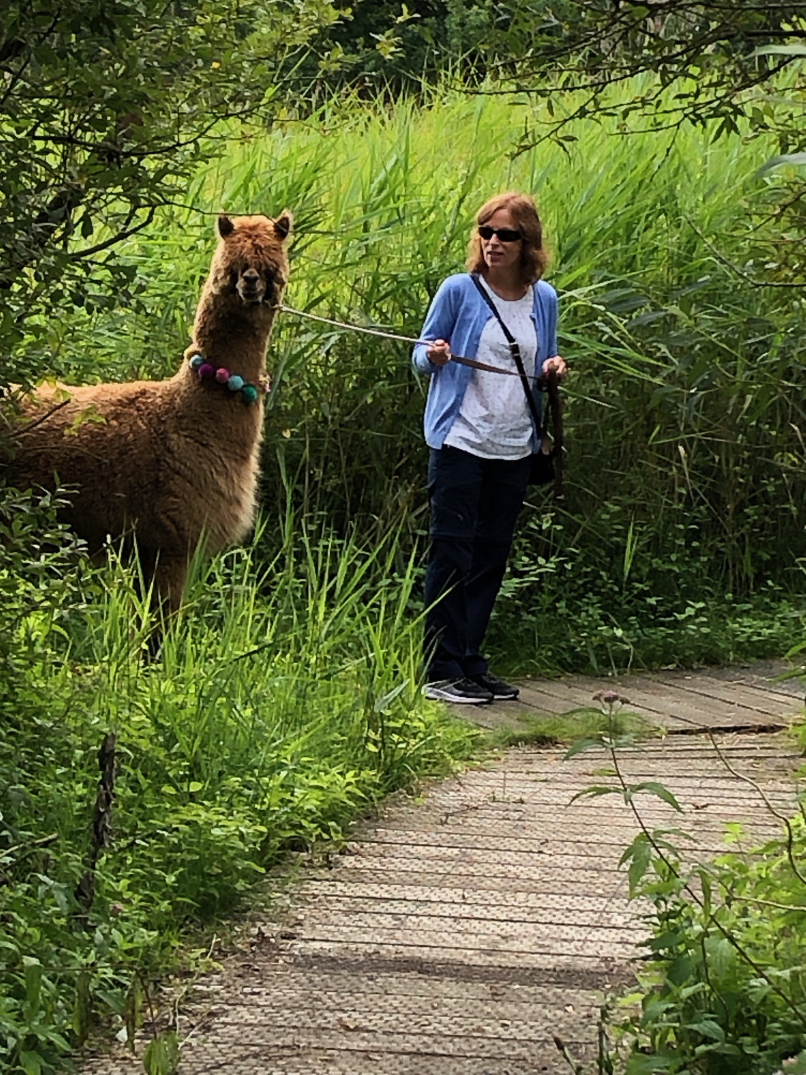
A couple of minutes later the regular troop of Alpacas processed along the boardwalk, and took a keen interest in the aftermath of the event. Luckily, they did not seem to have been traumatised by the recent explosion, unlike your correspondent, who took some persuading that he had not in fact been shot.

New volunteer Michelle had placed her backpack on the ground at the start of the session. On retrieving it at the end, she was surprised to find a couple of squatters had moved in.


Here’s the message of thanks from Team Leaders Julie and John:

Hello all

We ran another work party today clearing reed from the fen in the central area. Several of our regular volunteers were off doing other exciting things today, but the lovely weather attracted 15 volunteers anyway. We had old faces returning and new faces joining us and it was a lovely session and we cleared the reed, which had been cut in the week, with ease! Thank you to all involved.

Thanks also to Sheila for organising the refreshments for us today - they were very welcome as it was a warm day.

We will be back on the common in two weeks and will send the usual information on where we will be working nearer the day!

Enjoy the lovely weather.

Regards, Julie and John H