Monday, 25 October 2021

A tale with a twist

It might only be temporary, but the media are at last showing real interest in the conjoined climate and biodiversity crises, such that coverage is everywhere. Encouraged no doubt by the impending COP26 conference, and Prince William’s Earthshot prize awards, no-one in Britain can now be unaware of these issues. I only hope the focus stays on them once the media circus moves on. For my part, I take some comfort from knowing that my volunteering on our commons is making a small contribution. We know that peaty wet places have an even greater effect on removing carbon from the atmosphere than trees, so our efforts to keep our little patch in good order have real value. Having completed our scheduled work on the central fen area, we’re still currently working on the species-rich wet grassy areas alongside Warren Road. A major part of the task is to keep at bay the encroaching willow and alder trees – which if left unchecked would overwhelm the areas, and in drying them out actually release the carbon they’ve been busy storing. We’ve been splashing about in a lot of water there lately, and it occurs to me that the Common also acts as a great big sponge, probably preventing flooding in the area. Alongside all that of course, maintaining them helps to protect the many special plants growing there, and the myriad small (and largely un-surveyed) creatures depending on them, so in turning out at the weekend to do my bit, I’m ticking several boxes at once; that’s presumably what economists like to call productivity.

One of the many causes of biodiversity loss is out-competition by invasive non-native species, which with human help have managed to escape from the predators that had evolved alongside them in their far-away native homes. Over many years we have been pretty successful at controlling the spread of Himalayan Balsam, which can so devastate wet areas. There are many places nearby where this pernicious pest is not controlled, and the way it dominates those places serves as a warning to us to keep up our efforts. Very sadly, we have been powerless to control the spread of New Zealand Pigmyweed Crassula helmsii which first afflicted us on Scouts’ Pond (off the Jubilee Boardwalk), but has now spread to The Pit. Himalayan Balsam will have entered the wild having escaped from gardens; it’s all too easy for it, with its method of ‘exploding’ seeds into flowing water, enabling it to spread quickly along the watercourses it goes on to infest. Crassula was sold as a garden pond plant, and it’s easy to see how that got out. This wretched plant is easily transported from place to place on the fur or feathers of wildlife or pets, or the boots of people. Effective options for its removal are limited and expensive, so this is a problem that NWT may struggle to resolve. In the meantime, it is incumbent on us all to ensure our own pets don’t add to the problem, by keeping them out of the ponds.

Now that the opportunity has arisen to cut back the vegetation around the Pit, the extent of the infestation is horribly clear for all to see. Team Leader Julie reports: “Kevin ran a small work party on the Sunday following our last main work party, clearing the overgrown brambles, reed and shrubs to restore the three viewpoints into the pit. We also cut back the tree and shrub growth encroaching onto Pit Common. The reed in the Pit was also strimmed to reduce the growth in the water.

The Crassula is a real problem in the Pit and we couldn’t impact on that today but you can now see that there is water in the area. We all had to wash our equipment and boots when we came out of the water to prevent cross contamination from the Crassula.”

 here are some photos….

 Before we started.


During the session...


And after the session. 


Boot cleaning at the end…. Kevin clearly knows his place!!

Bailey managed to get a picture of a vole we saw by the Pit.

Here is Team Leader Kevin’s message of thanks:

Thank you very much to the restricted group of volunteers who came to Pit Common this morning. We have achieved an awful lot: cutting and removing weeds, brambles and nettles. Some of the trees were given a gentle trim as well. Opening up the viewpoints from the benches works really well.

We welcomed our new student volunteer. Thank you to Bailey for all his hard work. We look forward to seeing him at future work parties.

Regards, Kevin

 After a considerable drop of rain, the Pit now looks like this:


As with the fens further down the road, the Pit must be providing a free service to the village in holding at least some of the water rushing down Pit Street in times of flood.

 We have demonstrated before why we volunteers put so much effort into looking after our commons. Here is a picture of Area B taken in September 2012…

… and the same view in July 2021


And so to Sunday’s main event – completing the clearing of previously cut vegetation from Area A. A fortnight ago, the vote was put to the assembled company on whether now the equinox had passed we should revert to starting our sessions at 10.00 am. The cheers following that momentous act of democracy must have echoed round the village for some time, so two weeks on 22 bright-eyed and well-rested volunteers convened on the area bordering Warren Road. We were blessed with ideal weather for the job this time: not too hot, not too cold, with a bit of sunshine to keep us cheerful, and absolutely no precipitation, not of any kind. The windrows (or ricketts) were unsurprisingly undisturbed, so the task at hand was to transfer them to the four drag sheets as efficiently as possible, wet and heavy as they were.


A couple of windrows were close enough to the edge of the Alder carr for a group of highly motivated pitchfork wielders to transfer the stuff direct.


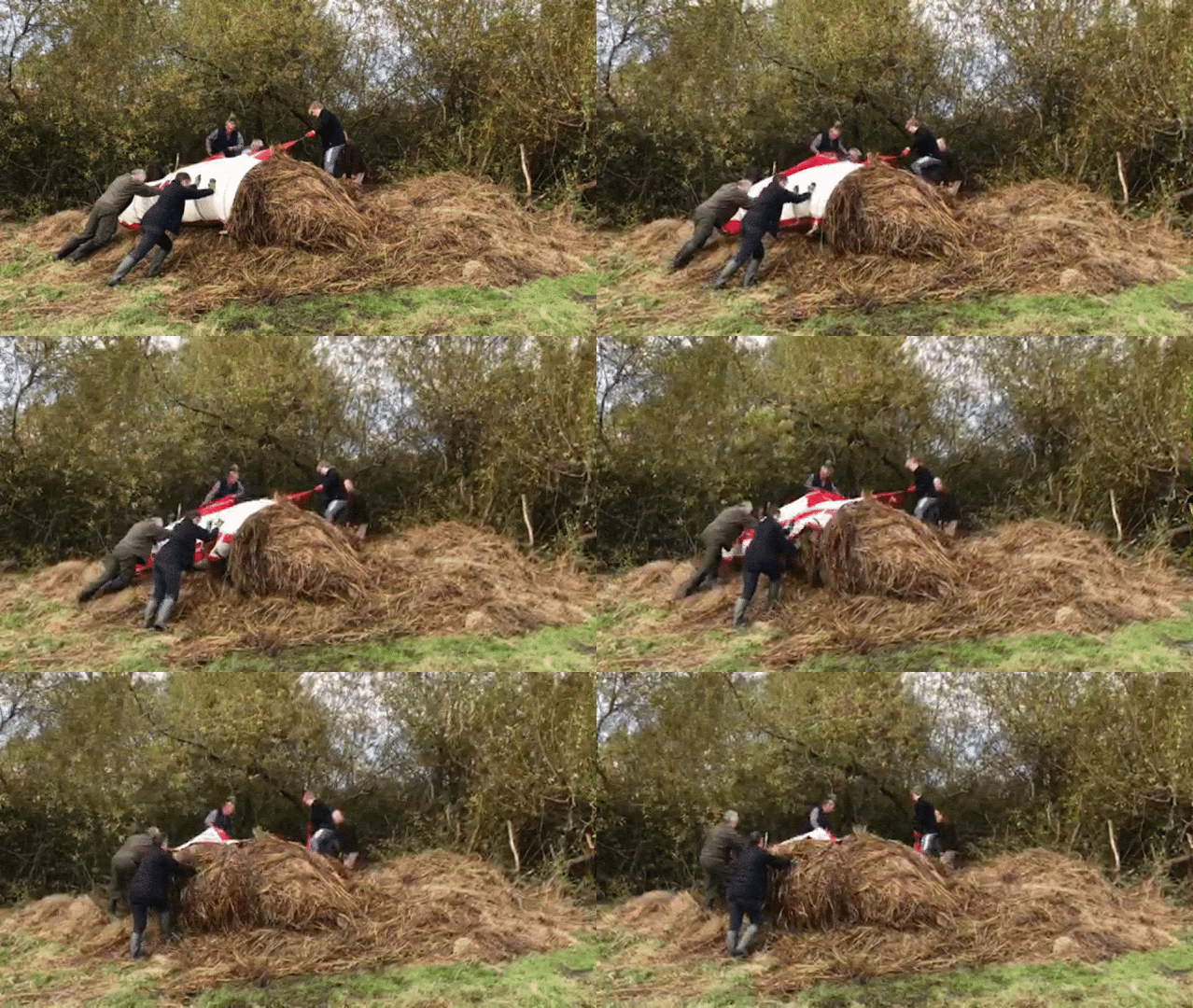
One of the challenges is the tipping over of the loaded sheet at the dumping point. Before we had the winch to help us, this was by far the most tiring part of the whole process, but even now a bit of manual intervention is sometimes called for.


The result is of course a growing heap, which initially at first assumes huge proportions…


.. but it does rot down and disappear remarkably quickly.

After an hour’s hard labour, the refreshment break was as welcome as ever.

We were struck by the layout of the abandoned pitchforks, most bearing their users’ gloves.


With so many people there we got the work done extremely well, and would probably have finished well within the scheduled two hours, if it had not been for The Twist. Unlike its worn-out predecessor, our new rope is determined to constantly twist itself whilst in use. Now a twisted rope makes winching impossible, as the convoluted loops it puts itself in will jam the drum on the winch – and that might mean we need another rope, or worse still, another winch. So the winch team found they had to painstakingly un-twist the wretched thing between each pull, greatly slowing down the normally very smooth operation, and causing them to work overtime (at double the usual rate of course!)

Here is how the area looked at that point:

The boardwalk edge between the car park and our storage container was also trimmed back.


Also previously cut stuff from along the boardwalk…

...was moved to a dump site further into the woody area...


...leaving the site looking much nicer.

Here is Team Leader Julie’s Message of thanks:

Dear volunteers

A huge thank you goes out to the team of volunteers who turned out this morning to finish the clearance of the cut reed on Area A. Due to the need to cut it before the end of September (to satisfy Natural England) this reed had been sat for several weeks and had become quite heavy to move. Most of it was moved onto the sheets for winching to the dump sites, but mention must be made to the small group who manually moved the reed near the bottom of the area onto a separate heap.

The winching operation was hampered today by issues with our new rope getting twisted. So special thanks also to those who ended up staying almost an extra hour to complete the dumping and painstakingly untwist the length of the rope at the end of the session.

Away from the main group we had people clearing cut scrub from the boardwalk edges to a dump site further back into the scrub and a lonely pair over the other side of the boardwalk clearing the boardwalk edges along to the car park. The entire boardwalk on the SSSI common is now passable with ease, so thank you to those who have worked at this over the weeks.   

There were a lot of people using the boardwalk this morning and enjoying the common, which was lovely to see.

We cannot begin cutting the areas of 'reed bed' until December so our outing in two weeks time will most likely be at School Common, but we will confirm this a few days before the work party.

Thanks for all your hard work and support - it is very much appreciated.

Regards, Julie (for the Team Leaders)

Sunday, 10 October 2021

Wet windrows and leaping Alpacas


Beguiled perhaps by what turned out to be an extravagantly optimistic weather forecast, 24 plucky volunteers turned up for another punishing encounter with the windrows of cut grass waiting to be shifted to the edge of Area A. Including yet another very welcome first-timer, this magnificent turnout is the biggest yet this year, and between us we put in a stunning 50 hours of work on Norfolk Wildlife Trust’s behalf!

As indicated, the weather was expected to be dry if uninspiring, leading many of our number to be ill-prepared for the precipitation, which kept changing from drizzle to quite heavy rain and back again.

With the temperature unseasonably warm, but wet-weather gear involved, the comfort factor was low, but through gritted teeth we still seemed to enjoy (is that how you spell endure?) the experience. The rain even almost stopped at the half-time break.

Natural England’s deadline for the cutting of this section was the end of September, so in order to meet that Grizzly driver Old Hand John and New Hand Dave finished the job on the last day possible, with Team Leader Margaret gamely creating the windrows (or rickles).


The idea of windrows is that they are left for a while to dry, which is fine, so long as the weather is fine. The intervening days had not been exclusively balmy however; indeed they had often been very wet. The inevitable consequence was of course that the material was soaked and heavy, but the pitchforking crew went at it with a will.

With so many people to help, all four drag sheets were in constant use, and there was scope for brush cutting and scrub trimming too, as well as grass mowing at The Pit. As regular readers of this blog will be all too aware, the main work consists of transferring the cut stuff onto a drag sheet

The sheet is then winched to the day’s dumping site…

…and then the winch is used to turn the sheet over (with a little manual help), resulting in a large heap for decomposition over the next few months.


This is quite a large area to clear, with limited options for dumping sites, so the heap is inevitably a big one, until it rots down. The doughty winch crew can still just be seen behind it:

A cynical reader (of which there are surely none of this blog) might wonder if there has been a trick with perspective here, and the people are a considerable distance back from the heap, or perhaps they are kneeling, or standing in a hole, but put that cynicism aside dear reader; this is a true and accurate reflection of the situation. Fortunately, we had the foresight to leave enough space for their escape at the close of play.

Once the work is done and the weary volunteers have trudged off home, the tools must still be returned to the storage container. Our famous little green cart is used for this purpose, but this time it was caught up in a small Camelid-related drama, as related by Team Leader Julie:

“Unfortunately I didn’t feel I could get my phone out when we met the Alpacas just past the Beck. We had a fully laden trolley which we couldn’t lift off the boardwalk or reverse back over the Beck … that would have been a disaster!

So they tried taking the Alpacas off the boardwalk but they were not keen - very sensible animals knew it wasn’t good ground!!

We eventually had to pull the trolley over to the very edge of the boardwalk and they managed to squeeze the Alpacas past! Only one fell off and he/she seemed none the worse for wear thank goodness.”

Loyal reader Brenda tells me that she was particularly taken with Julie’s lovely photos of Grass of Parnassus flowers in the previous couple of postings: this is a useful reminder that these beautiful and rare flowers are still present, so if you haven’t visited the Common recently, now is a good time to do so. Plenty of these and other plants can be readily seen from the boardwalk.

 Here is Team Leader Julie’s message of thanks:

Hello all

Thank you to the wonderful group of volunteers who turned out this morning and braved the rain. It wasn't the best weather for the job in hand. I lost count of the times I got wet and then dried out again throughout the session!

However, despite the weather we achieved a great deal. The largest group cleared cut reed from the top of Area A and created more 'rickles' (loosely piled heaps) of reed lower down Area A to aid clearance in the next session in two weeks’ time.

However, we also had smaller teams cutting back overgrown shrubs at the edge of the boardwalk near to the bridge over the Beck and brushcutting and sweeping the boardwalk from Bradfield Road around to the Central Area. Last, but definitely not least, one of our regular Pit Mowing volunteers mowed the grass around the Pit. 

An extraordinary effort from everyone today and we cannot tell you how grateful we are for your efforts. What a team!

We usually change our start time to 10am once the clocks change - and we had a quick vote at 'coffee time' and it was a resounding "Yes" to the later start time from the next session!

Regards, Julie (for the Team Leaders)

Sunday, 26 September 2021

Rickles or Windrows; you decide.

The last two weeks have again seen a great deal of voluntary work carried out on our commons; 44 ¼ hours have been clocked up between working parties! This includes a lot of ‘extra-curricular’ activity, mainly in order to be able to meet Natural England’s changed timescales which require a lot of the work to be completed within a short window between the end of summer and not very far into autumn.

First up was work at Pit Common on the 18th to cut back the vegetation around the pond – including the stuff that had grown up alongside the road. This had made it difficult to see the Pit itself, and it came as a surprise to your correspondent to realise just how much it has been invaded by the dreaded Crassula; a highly invasive and pernicious pond weed that belongs in New Zealand, where presumably there are things that keep it in check by eating it. Unfortunately, it seems to have no natural predators here, and once it infests an area it is extremely hard to eradicate.

Here's the view before the job:

And after:

Six volunteers got themselves very hot brush cutting and clearing away the resulting debris.

The next event was on Tuesday 21st, when the top portion of Area B was cut. The two areas adjacent to Warren Road, divided by the boardwalk, are meant to be cut on alternate years, but this part has become so invaded by reeds, bracken, Golden Rod and Michaelmas Daisies that it has been decided that an annual cut is required. This also had to be completed by the end of the month, but it was too much for us to clear away alongside the regular work, so on Friday 24th George, our NWT warden, came to do that, accompanied by a couple of volunteers who work with him at Cley. Team Leader Margaret and two other SCV stalwarts also helped out, logging another 5 ½ hours between them.

This Shield Bug also decided to put in an appearance

Here’s how the place looked after this Herculean effort

Two days later Team Leaders Margaret and Julie were out again, putting in another 5 ½ hours between them doing more back-breaking hand cutting of reeds on the wildflower-rich central area G, which Grizzly has finished with this year.

This arduous task is all about removing reeds from an area important for a range of flowering plants, as well as the mosses and liverworts that so excite the scientists. Perhaps none are lovelier than the Grass of Parnassus, beautifully captured by Julie:


The day before the main Sunday working party saw three people cutting more of Area A, followed by Team Leader Kevin going on to put in another 4 ¼ hours at The Pit. This ‘pre-cut’ was to provide a lot of material for the main group of volunteers to work on from the start of the session. The pressure is on to complete cutting the entire area by the end of the month, so even though we cannot clear it all by then, it should at least all be cut.

16 splendid volunteers arrived for Sunday’s main event on 26th. I’m not sure about the mellow fruitfulness, but Keats’s autumnal mists were in evidence when I woke with a scream not long enough after the post-equinoxial dawn. Not until late afternoon did the sun break through, but at least it refrained from cooking us at our labours on the famed Area A. Mind you, it was very humid, so rest assured, we still suffered.

Team Leader Margaret explained to us that the plan this time was not to solely concentrate on forking the cut vegetation onto the drag sheets, as there was no way it could all be shifted in the two-hour session. Instead, we were to also create ‘rickles’. These are defined as “loosely piled or disorganized heaps”, which sums us up pretty well I think. There was long and learned debate as to whether they can also be called windrows, which according to my dictionary are “long lines of raked hay drying in the wind”. They’re not exactly hay for equine consumption, but they are comprised mostly of a rich profusion of different grass species and other super plants, so ‘windrow’ seems equally acceptable. Here’s what they look like:

A recent appeal for more people to be trained in operating Grizzly yielded a willing volunteer, in the shape of recently recruited Dave. Under John’s expert and very experienced guidance he took to the skill very well; something that looks far too difficult for your correspondent to attempt.


I think we all take pleasure and pride in what we do on NWT’s behalf on our Common, and the winch team enjoys making ever more refinements to the process of moving a laden sheet across wet ground to be tipped out at the edge of the area being worked on. Your correspondent went so far as to boastfully say our work was slick, and winchman Noel has now adopted that has his middle name, so carry on Slick!

Not to be outdone by Friday’s Shield Bug, this six-legged spider showed up. It didn’t seem to walk with a limp, but having four legs on one side and being deficient on the other to the tune of two can’t be easy, so well done the plucky little arachnid!

Here is Team Leader Margaret’s message of thanks:

Hello all.

Once again I find that ‘thank you’ is really very inadequate for all the work you do. We have made excellent progress on clearing area A. The hope is that the rickles will dry and be lighter to lift in two weeks and that the other material can then be made into further rickles for later removal. We have several weeks of work still to do.

Thank you too to Dave who had his first session with grizzly and an excellent student he was too.

The pit often gets overlooked but there is always someone beavering away to maintain the area and cut the grass so thanks to the pit team.

We have also received some lovely comments from users of the commons who so appreciate the work you all do.

I saw my first skein of geese this morning so Autumn is upon us.

Thanks

Margaret for the team leaders

Sunday, 12 September 2021

Area A gets its trim


This being the relevant time of year, much of the countryside looks like it has had a haircut. Included in this must be our Common, which according to the decrees of Natural England has to be trimmed in line with a strict schedule. The central area having had its cut (except for a small remaining patch waiting until the end of the month), the section next up for the chop is the enigmatically named Area A. This is the bit beside Warren Road between Lower Street and the boardwalk, and is cut every other year, alternating with the section the other side of the boardwalk, which is unsurprisingly called Area B.

With two summers to grow in, the heady mix of grasses and many other plant species take full advantage, and a fine old tangle is the result. This makes for hard work for the Grizzly mower, and even harder work for the un-grizzly mower operators. Three pioneers spent two hours each on Wednesday, performing the ‘pre-cut’ to ensure there was something for the volunteers to work on from the start of the Sunday work session. Those three heroes are to be applauded, for the weather was hot and humid; something for which this summer has not hitherto been noted.

Here’s how it was when they left it:

On Saturday, Julie and Margaret continued the back-aching task of cutting reeds on the central part of the Common (Area G for your future reference). This allows for the required control of the spread of reeds into that area, whilst giving the special flowering plants growing there more time in which to flower and set seed before the final sweep of the mower. They might feel mad as hatters standing crouched over for an hour and half taking individual reeds out….but these beautiful Devil’s Bit Scabious and Grass of Parnassus flowers illustrate why they do it…


Sunday dawned bright, and all too early for my taste. The weather was initially pleasantly fresh, although as the morning wore on and the work became heavy, it did get a bit too warm for total comfort. Nonetheless, we applied ourselves to the task very much in the manner of teenage tennis prodigies, and in no time at all (well, two hours actually), a vast swathe of grass was mown and moved to the growing pile at the edge of the site.

It’s not all pitchforks and similar bucolic implements of course; machinery also figures large in our work. First and foremost, there’s the Grizzly mower – or in this case, where’s the Grizzly? As can be seen, the vegetation is tall and thick, unlike the driver, who is tall and thin.

Then there’s the vital winch. The crack winch team have discovered that it works best if the proper respect is shown, so bowing to it before asking it to pull anything is always a good idea.

Turning your back on it and pretending it’s not there rarely has the same effect…

Readers concerned about the fate of the little green trolley will be relieved to learn that it has been returned to service, having had the tender attention of the SCV Maintenance Department. John might not have just done what I would have done, and hit it with the biggest hammer he could find, but whatever engineering technique he employed, the result was that the vehicle can once again be steered along the boardwalk without falling off it, and that’s a considerable benefit. We also found that having tyres capable of retaining air makes it much easier to move; the trick was to slow it down on the slopes, so brakes might be the next request.

The vegetation will keep growing at this time of year, doing its best to make the boardwalk impassable, so Brush Cutter Brian was very usefully employed clearing the way. That’s a tough job, as is the sweeping of the trimmings off the boardwalk, ably performed by Dave; a more accomplished sweeper than can currently be found in the ranks of his beloved Norwich City it seems!

Half time came along not a moment too soon, as it was half way through the session. We took advantage of a hard surface for once to stand about on, enjoying tea, coffee and chocolate Bourbon biscuits.

Team Leader Julie spent a lot of time on her mud face pack, through being bent double clearing blockages from the ditch running down to the Beck alongside the western edge of the area. We think she enjoyed it, but her reply to our question was a bit ambiguous.

The nature of the vegetation in that area is that there is a lot of it; heavy and tangled, and still full of sap. Even more than the reed bed, this makes for especially hard work, and creates a lot of stuff to be moved. By the end of the session, an awful lot had been moved, but some was still there. It’s not something we like to do, but this time we left some piles, waiting for our attention next time.


Here is the Team Leaders’ message of thanks:

Once again I wish to thank all our volunteers for all the work you do on the Commons. Today you cheerfully gave up your time to help maintain the SSSI, it was hard hot work but you all got stuck in and achieved a huge amount.

Every two weeks our other unsung heroes of the pit mow the grass area, often in very hot conditions for the benefit of the whole village. Thank you.

It is only through your generosity of time and effort that we can all enjoy the Commons, not just the humans but getting that delicate balance for all the flora and fauna.

Margaret and all the team leaders