Sunday, 20 August 2023

Back again so soon?


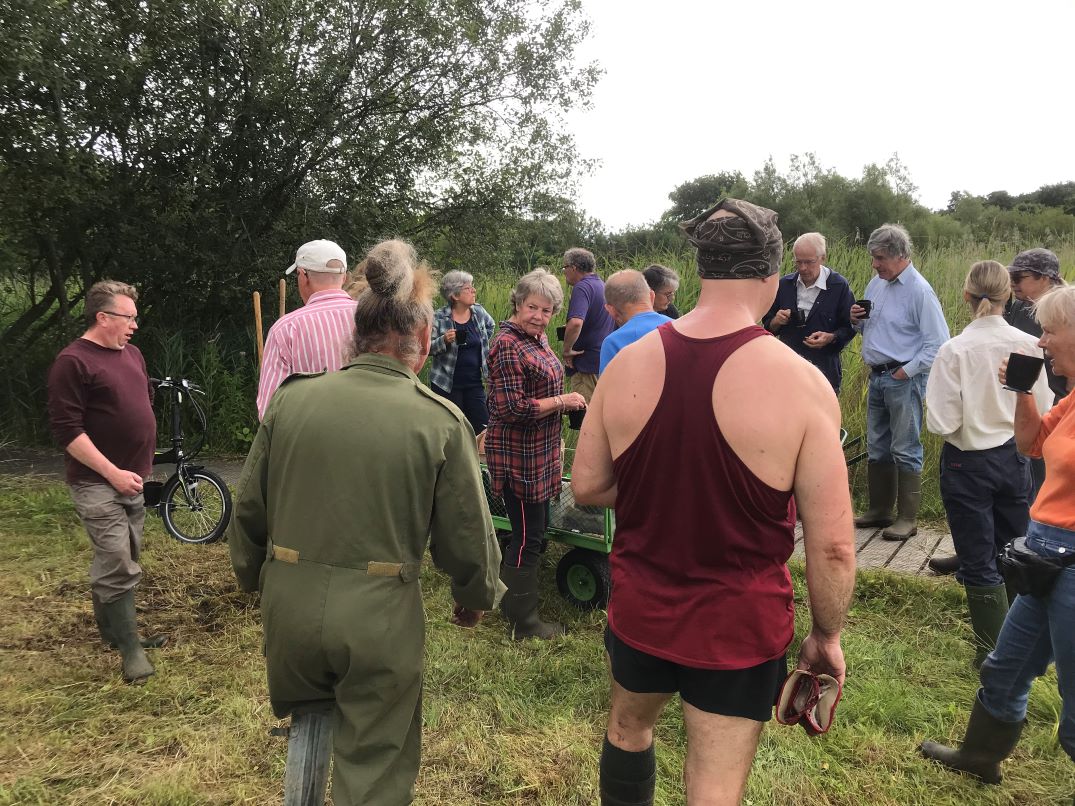
A mere seven days since the last session, 18 hardy volunteers returned to the Common this morning, at 9.00 am no less, in part to avoid the worst of the anticipated heat, but also to enable the viewing figures for the women’s World Cup Final to be boosted even more. The Met Office had not been wrong in their predictions (about the weather that is – I don’t know what they had thought the footy result would be), so on that basis alone the early start was well merited.

Those of us who like to turn up at these events at the appointed hour often find that others have arrived on site considerably earlier. My first intimation of this today was the sight of Noel’s splendid bicycle, before I found any actual people.

Then I spotted Team Leader Julie, single-handedly raking up the material from the “pre-cut” done a few days earlier (so that those of use who come later, or on time as we like to call it, have something to be getting on with).

Next to hove into view was Grillo the mower, operated by John, wearing a camouflaged hat, which is why I hadn’t seen him sooner – lucky not to be mown down!

As more people arrived, heaps of vegetation began to build. Being so light and hay-like, it was relatively easy to work with, which was a relief in view of the growing warmth. Speaking of hay, it did rather put your usual correspondent in mind of ahem, a Haywain…

By pitchfork or by hand, those heaps kept growing…

… and growing 


At the start of each session we count the tools out, and at the end we count them back in – at which point today we couldn’t account for one of the rakes. An extensive search was made, and here is a distant shot of Team Leader Kevin proudly brandishing the missing implement…

It had clearly moved from where it had last been left; a striking example of the rake’s progress (boom boom!)

Not only did the heaps on the drag sheets grow, but so too of course did the heap at the dumping site – where wise folk work; it’s cooler there.

Team Leader Julie is renowned as a builder of ‘dead hedges’, but her talents also extend to carefully crafted heaps, each strand of which she had moved there by hand. Not surprisingly, she looked pretty hot and tired by the time it had got this big.

Of course, the more efficient way is to drag a laden sheet to the dump site. “You pull that way, and I’ll go this way.”

Where it is tipped out. Turning it over can be hard going…

But there’s somehow still time for enjoyment (usually if someone gets half-buried).

It doesn’t always work smoothly of course

But despite the struggles, it can go tolerably well

By half-time we had completed clearing all that had been cut on the northern side of the boardwalk,

so it was time for refreshments.

Then it was off to the other side of the boardwalk, where Grillo had been busy cutting more material for our attention.

Eventually it was time to pack up, and for those who wanted to, rush back home to see how England’s Lionesses were doing. Sadly, they couldn’t quite get over the line, but as usual, Southrepps’ own Lionesses (and Lions) had been on top form again today.


Here is Team Leader Margaret’s message of thanks.

Thank you to the 18 volunteers who joined us on a very hot and humid morning. Thank goodness we started early! You are all never failing in your enthusiasm and work ethic. The whole area is looking good. I didn't realise just how hot and tired I was until I collapsed in front of the football. Well done Lionesses; just to make the final is a wonderful achievement.

Hopefully we will see you all again in two weeks to carry on where we left off. Have a restful afternoon.

Margaret for the team leaders.

Monday, 14 August 2023

The season begins!


It’s almost mid-August: the birdsong has more or less ceased, and the last few swifts are setting off on their migration back to Africa, where they spend the majority of their year. No doubt last weekend’s foul weather persuaded them it was time to go. Mark Cocker is a fabulous writer – one of the best of the current crop of nature writers – and his latest book is centred on these weird birds, of which there are about 100 species. It’s called One Midsummer’s Day: swifts and the story of life on Earth” and it, like the birds themselves, takes many loops and swoops around not only their story, but also touches on so much else. Cocker writes about the very early history of our planet and the emergence of life; the extraordinary amount of insect food to be found high in the sky by the swifts; the famously huge distances they travel in the course of their lives; the links between people and swifts; the nature of (and in) the atmosphere; and the vital importance of plants to us all. The swift here stands for the entirety of life in all its raging glory; in marvelling at it and how it’s come to be the way it is, we’re invited to marvel and care for every one of the “other 8.7 million varieties of earthling that we live alongside”. The final short chapter powerfully lists some of the many and complex problems facing Mother Earth and her inhabitants, and pleads for us to change our ways. It’s taken billions of years for us all to get to this point; it would be criminal to make it stop now. One Midsummer’s Day is a stunning piece of work, perhaps Cocker’s best, and of course it’s available from the library.

The first part of the main Common to be cut each season is the central section, and although the start of the job was delayed due to the previous weekend’s deluge, 17 volunteers converged on the site yesterday to do our bit to help keep the world in balance.

Before it all got fully under way, we here see two Johns looking at Grillo the mower in a puzzled way; ditto Team Leader Kevin with a rake

This is the area where many special plants grow, so it needs to be cut annually to ensure it is not overgrown by reeds or alder trees – but also care has to be taken not to chop off the heads of plants still to flower or set seed. The recent heavy rain had certainly made the going soft, but not enough to cause Grillo trouble, nor to get the volunteers excessively muddy. (Not being sure if we would have anyone to operate the winch, and bearing in mind the boggy nature of the ground, Noel had said we’d be ok with a pair of Clydesdales in snow shoes!)

As usual, the work was divided by those who went to mow…

… those who picked up that which had been mown…


… and those who went to worship that which had been mown.

Tea break came, to general relief. The weather wasn’t excessively warm, but it was muggy.

Noel announced he had come dressed as a Ghost Buster, but the general view was that he looked (if you squinted) like Tom Cruise in Top Gun. Although instead of operating a high-performance warplane, he was on the winch, so we renamed him Top Winch. You can see he has a blank label on his overalls. It should say ‘Maverick’ apparently, but we decided ‘Balsam’ was more appropriate. You decide.

Here we see ‘Balsam’ and friends struggling to overturn a laden drag sheet.


We were excited to find a Wasp spider . These are Samuel’s excellent picture of the striking arachnid.


Other wildlife seen today included possibly the area’s last two remaining swifts, a vole, a field mouse, a frog found by Julie on a drag sheet as she set it out at the start of the session…

… and a common lizard photographed by Team Leader Margaret. It’s nice to see one not on the boardwalk.

The relief at dumping the final load of the day is plain for all to see.

When we had finished, the area looked like this; plenty has been done, but there’s plenty more for next week! Taking into account the preparatory work before the main session, a further 41 hours of volunteer effort has been done on NWT’s behalf.

There are usually people walking across the boardwalk while we work, and this time a gentleman was there who had attended the local school during the second world war. He therefore knows the Common well, and recalled how School Common had been used during the war for military exercises, with some soldiers wearing German uniforms for the sake of realism. He also remembers the time an American bomber made an emergency landing in a nearby field: it was stripped of everything heavy so that it could take off back to its base for repairs.

Here is Team Leader Julie’s message of thanks:

Hello all

Thank you to the 17 volunteers who turned out today for our rescheduled work party.  It was a little humid, but the full sun and rain stayed away, so conditions were not too bad. The reed in this area is much lighter than on the reed bed and it was dry, so it was moved very quickly - we achieved an amazing amount and Grillo was kept busy cutting to keep up!

Thank you also to the three Grillo operators who worked yesterday to do the pre-cut and to clear the dump site.

We will return next week (as originally scheduled) to tackle more in the central area.

Have a good week.

 Regards, Julie (for the Team Leaders)


And finally, I had never heard of scorpion flies let alone known that they can be found here, but these photos were recently taken in a garden adjacent to the main Common. Fearsome to look at, but harmless and fabulous! 


Monday, 31 July 2023

In praise of the Wellington boot


“If it wasnae for your wellies, where would you be?

You'd be in the hospital or infirmary

Cause you would have a dose of the flu or even pleurisy

If you didnae have your feet in your wellies!”

Billy Connolly used those immortal lines to illustrate the deprived nature of his Glasgow upbringing, but those of us who volunteer on Southrepps Common know how true they are. Our most recent working party was another foray into the jungly domain of the dreaded and dreadful Himalayan Balsam. To reach a rich vein of it, a tributary to the mighty Fox’s Beck had to be crossed, and the chance of filling up your wellies with a portion of the Beck was depressingly high. However, a cunningly contrived temporary bridge consisting of a fallen and rotting tree limb allowed three plucky pioneers to cross the raging torrent, albeit tentatively and helped by the overhanging branches. Four others kept their wellies relatively dry by pushing through the reeds to the Beastly Balsam clustering on the nearer side of The Beck. 

This was the first attendance of very welcome new recruit Andrew, here proudly displaying his inaugural trophy Balsam plant.

Given that we had visited this very spot a fortnight ago, it was depressing to find a significant new growth of plants; although small, they're still capable of sporting flowers and therefore producing seeds.

From the surprisingly small to the as-expected tall; we reckoned these checked in at about nine or ten feet!

Despite a further seven volunteer hours being put in, making a total of 68.5 hours on this task this summer, there are still a lot of hard to reach plants – but at least we’ve done a lot to control Balsam's spread for another year.

Meanwhile, the wild flower patch at Pit Common was also cut by two other volunteers, to be raked off in a few days’ time once the seeds have had a chance to drop back onto the area. So it looks like it’s a success!

Here is Team Leader Margaret’s message of thanks:

Thank you so much to the volunteers who came again today. It was hard work as the Balsam has got taller and the reeds, hops and cleavers thicker! As we are now entering the cutting season that will be the last Balsam Bash, so thank you all for your hard work. Progress is being made and we are stopping it taking over the site.

I would also like to thank the chaps who cut the meadow at the Pit this morning. The arisings are being left to allow the seeds to drop and then they will be raked off.

Hope to see many of you next Sunday.

Margaret for the team leaders.

    Before that session though, last Saturday our three keenest Balsam Bashers, along with NWT’s Annabel, insisted on enjoying it yet more at the Warren Road end and then at the edge of the Beck on the other side of the boardwalk, clocking up six more volunteer hours.

At the Warren Road end they discovered this chrysalis, very close to where a peacock caterpillar had been found on 2nd July, as recorded on this very blog. So we’re pretty sure because of that and comparing it with online photos that it’s going to grow up to be a Peacock butterfly, probably later this summer, ready to spend the winter hibernating.

They created a new heap for the stuff to decompose in, with two further bags joining the existing one back behind the Information Point.

They reported that the Beck is flowing well where a big branch is down across it - we saw this a while back and wondered if it would be an issue - but apparently not! 


Pulling up invasive plants and cutting reed is not the only volunteering we do on NWT’s behalf. We also keep a close eye on the flora and fauna found on the five commons, including passing on to the Trust the sightings reported on the whiteboard on the Information Point at the Lower Street end of the boardwalk.

At around 500, plants represent by far the largest number of species known to be present (invertebrates might outnumber them, but so far have not been thoroughly surveyed). In addition to the ad-hoc reporting of sightings, every year a small group of dedicated botanists led by Team Leader Sue do a regular survey of the main Common, for onward reporting to NWT and Natural England (the body which oversees Sites of Special Scientific Interest, such as this one). Prior to 2020 the surveys were undertaken by specialist ecologists on behalf of Natural England, but since then it has been down to our resident experts.

The plots to be surveyed, known as quadrats, are marked out with canes in the central part of the Common, concentrating particularly on the range of exciting flowering plants and intriguingly named mosses such as Yellow Starry Feather moss and Rusty Hook-moss growing there.

There are buried metal markers for precise location of the right spots - hence Sue can be seen wandering around with a metal detector to find where to place the canes.

Here are a normal pink Fragrant orchid and a more unusual white Fragrant orchid found during the most recent survey, near, but not quite in a survey plot.


When you are puzzled by the sight of a group of people staring intently at the ground in the middle of the Common on a hot summer’s day, now you’ll know what they’re up to!


Sunday, 16 July 2023

Back on the Balsam again

 Perhaps because the Spring was quite cold this year, insect life has taken a long time to get going, but at last it now seems to be in full swing. Butterflies have gone from being almost completely absent to very much present on the roll call, with plenty of Speckled Woods, Ringlets, Meadow Browns and Red Admirals about. Very excitingly, just this morning a White Admiral was seen at the edge of School Common. This rather pleasing Speckled Wood was on one of our local footpaths.

In the last week or so I have been noticing lots of Gatekeepers along the hedgerows, while this splendid Tortoiseshell has been so far the only representative of its species to cross my path (also not on the Common however.)

The trouble with butterflies is that they often won’t stay still long enough for them to have their pictures taken, but on a recent visit to the excellent RSPB reserve at Strumpshaw fen this Gatekeeper did pause its fluttering long enough for a quick snap, showing its under-wing.

The other summer standby for spotting, when birds have gone into hiding, is the Odonata (dragonflies and damselflies); also at Strumpshaw was this obliging Broad-bodied Chaser, one of which we found on the Common a few weeks back.

We’ve had Hornet mimic Hoverflies on the Common previously, but this is one I saw on one of the nearby lanes. I trust it wasn’t the one that blundered into my house late one evening soon after; they’re very active and noisy, and not a little alarming (though harmless of course).

Hogweed is now in flower, and therefore the Hogweed ‘bonking’ beetles are swarming all over them. Think Love Island for beetles and you’ve got it!

The warm and slightly wetter weather lately has caused the Common’s vegetation to take off in spectacular fashion. Our current focus remains trying to prevent Himalayan Balsam from swamping the place, so today 13 of us turned up to rebuke the wretched stuff growing near the Lower Street car park. This particular area is quite hard to access, so Team Leader Margaret gave us stern warnings before we set off into the jungle. It’s important to dress to protect yourself from nettle stings; we were particularly impressed by the sensible but beautifully ironed boiler suit modelled by Louise. Wellies are essential too; sadly for Noel, his sprang a leak.

Careful selection of the right plant to pluck up is key; here Andrew illustrates the correct technique.

Due to the problems caused by the terrain, we were urged to work in pairs. Your correspondent and the aforementioned Andrew bravely opted to cross the Beck to deal with some of the hardest to reach and largest specimens. This one has grown tall enough to peer over the neighbours’ fence.

Once the allotted hour was up we reluctantly (ahem) dragged ourselves away. Now that the bigger plants are flowering, it’s important to try to stop them setting seed. There is unfortunately still plenty left to do, so there will need to be at least one more session.

Between us we put in another 13 hours work today: so far this year we’ve collectively done 55.5 hours on Himalayan Balsam control alone!

Here is Team Leader Margaret’s message of thanks:

Hi all.

A very heartfelt thankyou to the 13 volunteers who came this morning to continue the never-ending battle with the balsam. It was particularly challenging today as the bindweed, hop and stickyweed were determined to block our path. It was very hard work so thank you all.

The good news is that I do think there was less balsam on the main site than last year but not unfortunately across the Beck. With your fantastic efforts we are managing to control it.

I would very much like to have yet another go in two weeks’ time so hopefully see anyone who is willing then.

Margaret (on behalf of the team leaders).